Hand-signed and numbered.
Etching on Arches watermark.
Published by Editor Maeght, Paris, 1950.
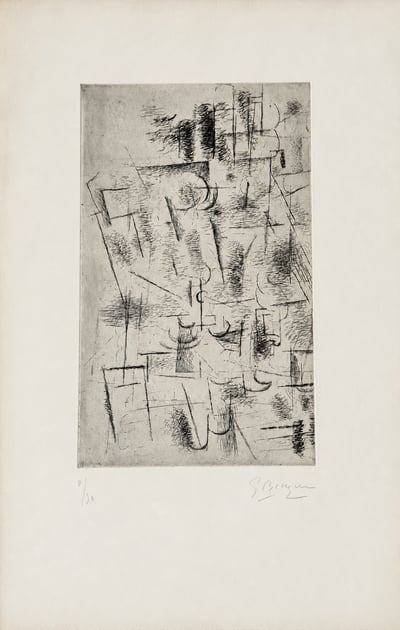
Still Life with Glass by Georges Braque is an etching based on a composition originally created in 1912, one of the formative years of Cubism, and published by Maeght Éditeur in Paris in 1950. The composition fragments the traditional still life into an intricate arrangement of intersecting lines, geometric planes, and subtle tonal variations, suggesting objects such as a glass and tabletop without depicting them literally. Braque’s restrained use of black line and delicate hatching emphasizes structure, rhythm, and spatial ambiguity, inviting viewers to reconstruct the image through careful observation. Closely associated with the development of Analytic Cubism alongside Pablo Picasso, the work reflects Braque’s pioneering exploration of multiple viewpoints and the breakdown of conventional perspective. Printed on Arches paper with the publisher’s watermark, this hand-signed etching is from the numbered edition of 50.
Georges Braque (France, 1882–1963) was a seminal figure in modern art and a co-founder of Cubism alongside Pablo Picasso. His work, characterized by fragmented forms and muted palettes, explored the interplay between perspective and abstraction. Later, he developed the papier collé technique, influencing the evolution of collage and modern painting.
EtchingEtching is a technique where a design is created on a metal surface by using a strong acid or mordant to eat away the unprotected parts of the metal, leaving the desired pattern in relief (intaglio). In modern art and manufacturing, different chemicals may be used depending on the material being etched.
Hand-signed and numbered.
Etching on Arches watermark.
Published by Editor Maeght, Paris, 1950.
Still Life with Glass by Georges Braque is an etching based on a composition originally created in 1912, one of the formative years of Cubism, and published by Maeght Éditeur in Paris in 1950. The composition fragments the traditional still life into an intricate arrangement of intersecting lines, geometric planes, and subtle tonal variations, suggesting objects such as a glass and tabletop without depicting them literally. Braque’s restrained use of black line and delicate hatching emphasizes structure, rhythm, and spatial ambiguity, inviting viewers to reconstruct the image through careful observation. Closely associated with the development of Analytic Cubism alongside Pablo Picasso, the work reflects Braque’s pioneering exploration of multiple viewpoints and the breakdown of conventional perspective. Printed on Arches paper with the publisher’s watermark, this hand-signed etching is from the numbered edition of 50.
Georges Braque (France, 1882–1963) was a seminal figure in modern art and a co-founder of Cubism alongside Pablo Picasso. His work, characterized by fragmented forms and muted palettes, explored the interplay between perspective and abstraction. Later, he developed the papier collé technique, influencing the evolution of collage and modern painting.
Art is made to disturb. Science reassures.
- Georges Braque
Georges Braque (b. 1882 France, d. 1963 France) was a French painter, collagist, and sculptor who, alongside Pablo Picasso, is credited with developing Cubism, one of the most influential art movements of the 20th century. Braque's early work was influenced by Fauvism, characterized by vibrant colors and bold brushwork. However, his collaboration with Picasso around 1907 marked a significant shift in his style, leading to the development of Analytical Cubism, which deconstructed objects into geometric shapes and depicted multiple perspectives within a single plane. Later, he transitioned to Synthetic Cubism, incorporating elements such as stenciled text and collage into his paintings. Braque's work is known for its subtle use of color, intricate compositions, and a focus on everyday objects, often emphasizing the tactile qualities of surfaces. His exploration of form and space had a profound impact on the trajectory of modern art, and his works are held in major museums worldwide, including the Louvre in Paris and the Museum of Modern Art in New York.
Cubism is an art movement that aimed to depict multiple perspectives of objects or figures within a single picture. Artists Georges Braque and Pablo Picasso pioneered this style around 1907. The name Cubism emerged from their use of geometric shapes and outlines that often resembled cubes, breaking objects down into abstracted forms.