Color Lithograph on Arches paper.
- Published by XXe Siècele, Paris/ Printed by Mourlot, Paris.
- Reference: Vallier 178, Mourlot 117.
- Image Size: 12 3/8 in x 10 1/2 in (31 cm x 26 cm)
- Sheet Size: 22 in x 16 1/2 in (55.9 cm x 41.9 cm)
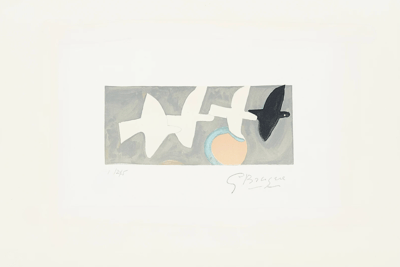
Oiseaux #178 (1962) by Georges Braque is a color lithograph printed on Arches paper and published in Paris for the influential art magazine XXe Siècle, produced by Gualtieri di San Lazzaro. The print was executed at the renowned Atelier Mourlot, one of the most important print workshops in twentieth-century modern art.
The composition reflects Braque’s enduring fascination with birds, a motif that dominated his late career. Several dark silhouettes glide across a soft, pale pink sky, their wings stretched in different positions of flight. The simplified shapes emphasize movement and rhythm rather than anatomical detail. Toward the lower portion of the image, the forms dissolve into abstract shapes resembling clouds or distant shadows, creating a sense of atmospheric depth and tranquility.
Braque’s bird imagery symbolized freedom, contemplation, and harmony. In this lithograph the contrast between the deep black figures and the muted background creates a quiet, meditative scene that evokes balance and calm.
Georges Braque (France, 1882–1963) was a seminal figure in modern art and a co-founder of Cubism alongside Pablo Picasso. His work, characterized by fragmented forms and muted palettes, explored the interplay between perspective and abstraction. Later, he developed the papier collé technique, influencing the evolution of collage and modern painting.
Lithograph Lithography is a printing method based on the principle that water and oil do not mix. It can be used to print artwork or text onto paper or other suitable materials. Traditionally, an image was drawn with wax, fat, or oil onto a lithographic limestone surface or plate. Today, metal plates and other surfaces are also used in lithographic printing.
Color Lithograph on Arches paper.
- Published by XXe Siècele, Paris/ Printed by Mourlot, Paris.
- Reference: Vallier 178, Mourlot 117.
- Image Size: 12 3/8 in x 10 1/2 in (31 cm x 26 cm)
- Sheet Size: 22 in x 16 1/2 in (55.9 cm x 41.9 cm)
Oiseaux #178 (1962) by Georges Braque is a color lithograph printed on Arches paper and published in Paris for the influential art magazine XXe Siècle, produced by Gualtieri di San Lazzaro. The print was executed at the renowned Atelier Mourlot, one of the most important print workshops in twentieth-century modern art.
The composition reflects Braque’s enduring fascination with birds, a motif that dominated his late career. Several dark silhouettes glide across a soft, pale pink sky, their wings stretched in different positions of flight. The simplified shapes emphasize movement and rhythm rather than anatomical detail. Toward the lower portion of the image, the forms dissolve into abstract shapes resembling clouds or distant shadows, creating a sense of atmospheric depth and tranquility.
Braque’s bird imagery symbolized freedom, contemplation, and harmony. In this lithograph the contrast between the deep black figures and the muted background creates a quiet, meditative scene that evokes balance and calm.
Georges Braque (France, 1882–1963) was a seminal figure in modern art and a co-founder of Cubism alongside Pablo Picasso. His work, characterized by fragmented forms and muted palettes, explored the interplay between perspective and abstraction. Later, he developed the papier collé technique, influencing the evolution of collage and modern painting.
Art is made to disturb. Science reassures.
- Georges Braque
Georges Braque (b. 1882 France, d. 1963 France) was a French painter, collagist, and sculptor who, alongside Pablo Picasso, is credited with developing Cubism, one of the most influential art movements of the 20th century. Braque's early work was influenced by Fauvism, characterized by vibrant colors and bold brushwork. However, his collaboration with Picasso around 1907 marked a significant shift in his style, leading to the development of Analytical Cubism, which deconstructed objects into geometric shapes and depicted multiple perspectives within a single plane. Later, he transitioned to Synthetic Cubism, incorporating elements such as stenciled text and collage into his paintings. Braque's work is known for its subtle use of color, intricate compositions, and a focus on everyday objects, often emphasizing the tactile qualities of surfaces. His exploration of form and space had a profound impact on the trajectory of modern art, and his works are held in major museums worldwide, including the Louvre in Paris and the Museum of Modern Art in New York.
Cubism is an art movement that aimed to depict multiple perspectives of objects or figures within a single picture. Artists Georges Braque and Pablo Picasso pioneered this style around 1907. The name Cubism emerged from their use of geometric shapes and outlines that often resembled cubes, breaking objects down into abstracted forms.