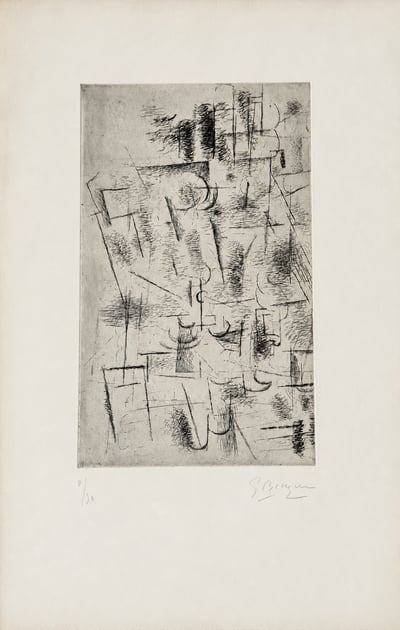
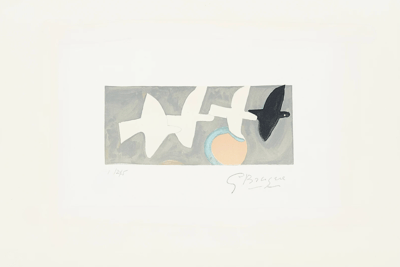
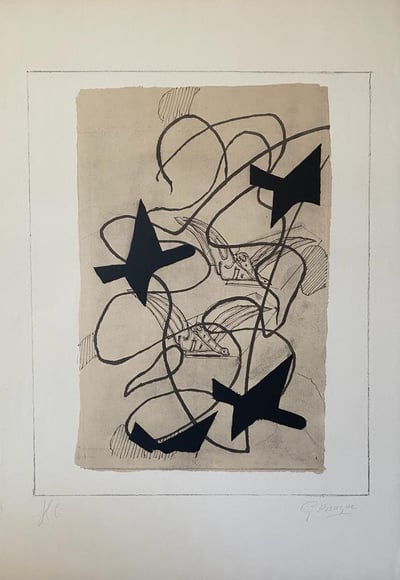
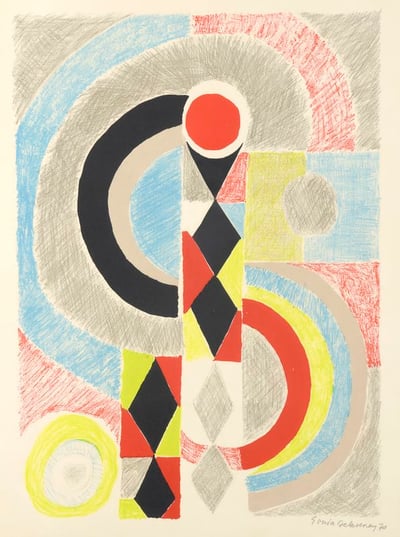
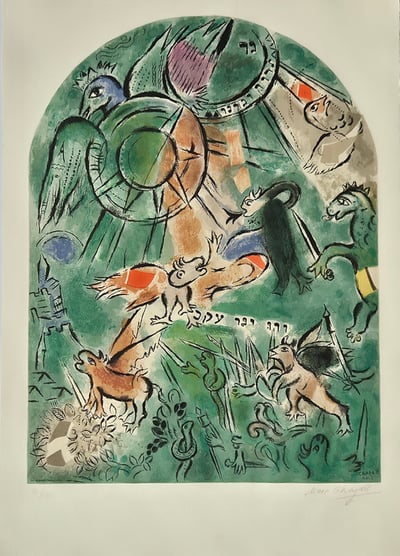
Lithograph in colors on wove appliqué to Arches support - Reference: Vallier 1046
- Image: 14 5/8 in x 11 1/8 in (37.2 cm x 28.2 cm)
- Sheet: 22 1/4 in x 15 in (56.7 cm x 38 cm)
Georges Braque's La Chaise M #1046, a 1962 limited edition lithograph, measures 56.5 x 38.1 cm and is printed on wove paper mounted on Arches support. This artwork showcases Braque's ability to transform everyday objects into captivating visual experiences. Depicting a chair, the composition is rich in color, with swirling lines and vivid hues of purple, green, and orange that add vibrancy and energy. The brushwork and texture evoke a sense of movement and depth, emphasizing Braque's skill in turning simple motifs into complex compositions. The lithograph balances abstraction and representation, inviting viewers to appreciate its harmony and expressive quality.
Georges Braque (France, 1882–1963) was a seminal figure in modern art and a co-founder of Cubism alongside Pablo Picasso. His work, characterized by fragmented forms and muted palettes, explored the interplay between perspective and abstraction. Later, he developed the papier collé technique, influencing the evolution of collage and modern painting.
Lithograph Lithography is a printing method based on the principle that water and oil do not mix. It can be used to print artwork or text onto paper or other suitable materials. Traditionally, an image was drawn with wax, fat, or oil onto a lithographic limestone surface or plate. Today, metal plates and other surfaces are also used in lithographic printing.
Lithograph in colors on wove appliqué to Arches support - Reference: Vallier 1046
- Image: 14 5/8 in x 11 1/8 in (37.2 cm x 28.2 cm)
- Sheet: 22 1/4 in x 15 in (56.7 cm x 38 cm)
Georges Braque's La Chaise M #1046, a 1962 limited edition lithograph, measures 56.5 x 38.1 cm and is printed on wove paper mounted on Arches support. This artwork showcases Braque's ability to transform everyday objects into captivating visual experiences. Depicting a chair, the composition is rich in color, with swirling lines and vivid hues of purple, green, and orange that add vibrancy and energy. The brushwork and texture evoke a sense of movement and depth, emphasizing Braque's skill in turning simple motifs into complex compositions. The lithograph balances abstraction and representation, inviting viewers to appreciate its harmony and expressive quality.
Georges Braque (France, 1882–1963) was a seminal figure in modern art and a co-founder of Cubism alongside Pablo Picasso. His work, characterized by fragmented forms and muted palettes, explored the interplay between perspective and abstraction. Later, he developed the papier collé technique, influencing the evolution of collage and modern painting.
Art is made to disturb. Science reassures.
- Georges Braque
Georges Braque (b. 1882 France, d. 1963 France) was a French painter, collagist, and sculptor who, alongside Pablo Picasso, is credited with developing Cubism, one of the most influential art movements of the 20th century. Braque's early work was influenced by Fauvism, characterized by vibrant colors and bold brushwork. However, his collaboration with Picasso around 1907 marked a significant shift in his style, leading to the development of Analytical Cubism, which deconstructed objects into geometric shapes and depicted multiple perspectives within a single plane. Later, he transitioned to Synthetic Cubism, incorporating elements such as stenciled text and collage into his paintings. Braque's work is known for its subtle use of color, intricate compositions, and a focus on everyday objects, often emphasizing the tactile qualities of surfaces. His exploration of form and space had a profound impact on the trajectory of modern art, and his works are held in major museums worldwide, including the Louvre in Paris and the Museum of Modern Art in New York.
Cubism is an art movement that aimed to depict multiple perspectives of objects or figures within a single picture. Artists Georges Braque and Pablo Picasso pioneered this style around 1907. The name Cubism emerged from their use of geometric shapes and outlines that often resembled cubes, breaking objects down into abstracted forms.