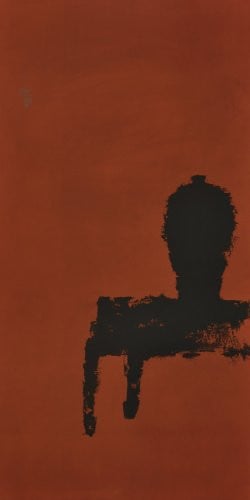
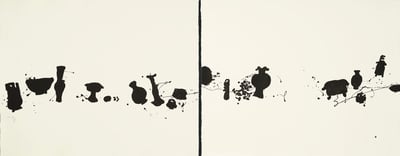
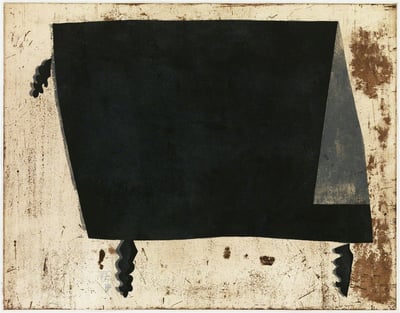
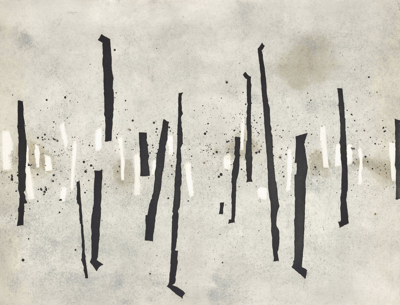
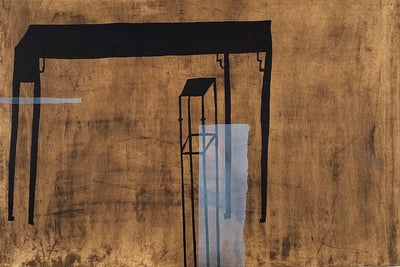
The Families 1 by Wang Huai-Qing is a 2012 limited edition diptych etching, created in an edition of 60. This artwork presents two panels featuring black silhouettes of various traditional Chinese objects, such as vases, teapots, and figurines, spread horizontally across a pale background. The objects are depicted as solid black shapes, with splatters and fragmented lines connecting them, suggesting a sense of movement or history. The diptych format amplifies the sense of continuity and separation, reflecting on the themes of heritage, family bonds, and the passage of time. Wang’s piece invites contemplation on cultural legacy, with everyday objects serving as symbols of memory and tradition.
Wang Huai-Qing (China, 1944) is a contemporary artist celebrated for blending traditional Chinese calligraphy with modern abstraction. His bold, minimalist compositions often deconstruct classical motifs, creating a dialogue between heritage and innovation. Using ink and oil, Wang reimagines Chinese visual culture in a global context.
Diptych with 2 etchingsEtching is a technique where a design is created on a metal surface by using a strong acid or mordant to eat away the unprotected parts of the metal, leaving the desired pattern in relief (intaglio). In modern art and manufacturing, different chemicals may be used depending on the material being etched.
Size
Inches
Centimeters
75 X 95 cm
Edition
Edition of 60
Price
USD
EUR
GBP
CHF
4,300EUR
?
+ VAT/import Duties (if applicable)
Authenticity Guaranteed
Insured Shipping
Online Since 2005
Share
●Inventory 3000
●Signed
●Comes with gallery invoice and certificate
●Any questions?
Diptych with 2 etchings
The Families 1 by Wang Huai-Qing is a 2012 limited edition diptych etching, created in an edition of 60. This artwork presents two panels featuring black silhouettes of various traditional Chinese objects, such as vases, teapots, and figurines, spread horizontally across a pale background. The objects are depicted as solid black shapes, with splatters and fragmented lines connecting them, suggesting a sense of movement or history. The diptych format amplifies the sense of continuity and separation, reflecting on the themes of heritage, family bonds, and the passage of time. Wang’s piece invites contemplation on cultural legacy, with everyday objects serving as symbols of memory and tradition.
Wang Huai-Qing (China, 1944) is a contemporary artist celebrated for blending traditional Chinese calligraphy with modern abstraction. His bold, minimalist compositions often deconstruct classical motifs, creating a dialogue between heritage and innovation. Using ink and oil, Wang reimagines Chinese visual culture in a global context.
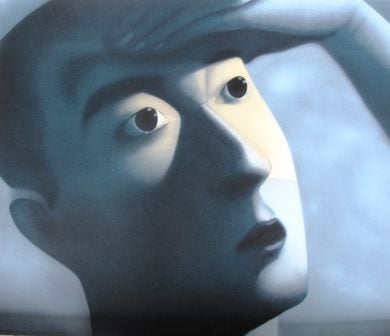
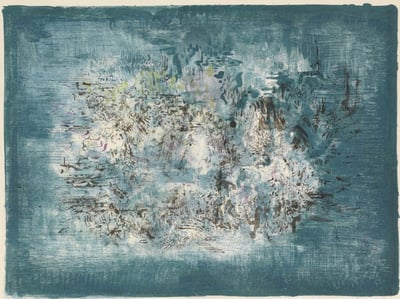
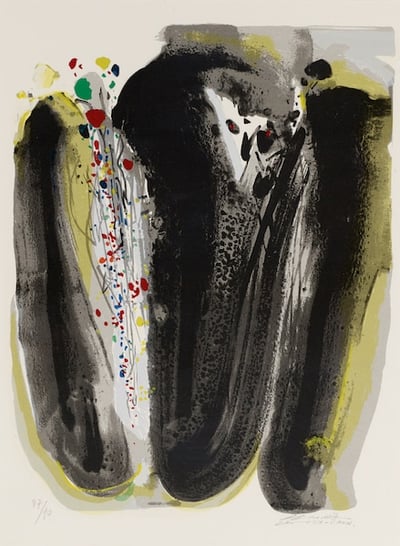
Huai-Qing Wang (b. 1944, China) is a Chinese artist renowned for his unique approach to contemporary Chinese painting, blending traditional techniques with modern abstract forms. His work often explores the tension between the ancient and the modern, the East and the West, using a minimalist palette of ink and color on paper to create powerful, contemplative compositions. Wang's art is deeply influenced by Chinese philosophy and calligraphy, as well as Western modernist movements, resulting in a style that is both introspective and universal. His abstract landscapes and figures, often rendered in a gestural, almost calligraphic manner, evoke a sense of spiritual depth and harmony. Wang's work has been widely exhibited in China and internationally, establishing him as a significant figure in the global contemporary art scene.
Chinese Contemporary Art is marked by a wide range of styles and experimental approaches. In the 1980s, avant-garde exhibitions were often shut down by government officials. The 1990s saw the rise of political pop and cynical realism, while China's One-Child Policy influenced artists to explore the individual as a subject matter.