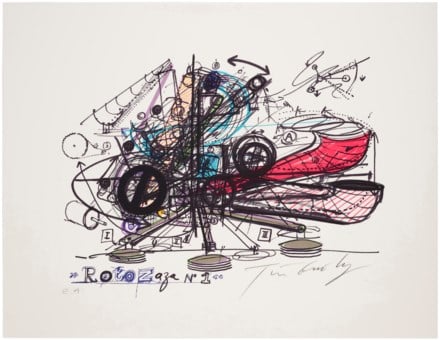
// Jean Tinguely’s Roto Zaza No. 1 (1975) is a screen print that embodies his fascination with kinetic art and mechanical forms. The composition is a dynamic, chaotic assembly of abstract shapes, mechanical components, and lines that suggest movement and energy. Vivid colors, including bold reds and blacks, intertwine with sketch-like marks, evoking a machine-like structure that appears in constant motion. The overlapping forms and energetic lines reflect Tinguely's playful yet industrial aesthetic, encouraging viewers to imagine a machine that exists purely in the imagination, where functionality merges with artistic expression.
Jean Tinguely (Switzerland, 1925–1991) was a Swiss sculptor renowned for his kinetic art, creating mechanical sculptures that often satirized automation and the overproduction of material goods. His notable works include 'Homage to New York' (1960), a self-destructing sculpture exhibited at the Museum of Modern Art in New York.
Screen-print Screen printing is a technique where ink is transferred through a mesh onto a substrate, with areas blocked by a stencil to prevent ink from passing through. This method, also known as serigraphy or silkscreen printing, is commonly used to produce prints on posters, T-shirts, vinyl, stickers, wood, and other materials. The process is a type of stencil printing, allowing for vibrant, detailed designs on various surfaces.
// Jean Tinguely’s Roto Zaza No. 1 (1975) is a screen print that embodies his fascination with kinetic art and mechanical forms. The composition is a dynamic, chaotic assembly of abstract shapes, mechanical components, and lines that suggest movement and energy. Vivid colors, including bold reds and blacks, intertwine with sketch-like marks, evoking a machine-like structure that appears in constant motion. The overlapping forms and energetic lines reflect Tinguely's playful yet industrial aesthetic, encouraging viewers to imagine a machine that exists purely in the imagination, where functionality merges with artistic expression.
Jean Tinguely (Switzerland, 1925–1991) was a Swiss sculptor renowned for his kinetic art, creating mechanical sculptures that often satirized automation and the overproduction of material goods. His notable works include 'Homage to New York' (1960), a self-destructing sculpture exhibited at the Museum of Modern Art in New York.
To me art is a form of manifest revolt, total and complete.
- Jean Tinguely
Jean Tinguely was a Swiss sculptor and painter who was most well known for his creations of kinetic art, known technically as meta-mechanics, in the grand Dada tradition. Jean Tinguely’s basic purpose for his art is to lampoon the unconscious over-creation of material items in modern industry. Jean Tinguely’s best known work was Homage to New York, which he designed to destroy itself. However, it did not completely self-destruct in its exhibition at the Museum of Modern Art in New York City. A later work,Study for an End of the World No. 2, was successful in its self-destruction when shown for an audience in the desert near Las Vegas. Some of his more well known public works include Chaos I, in Columbus Indiana; the Tinguely Fountain in Basel; the Jo Siffert Fountain in Fribourg, Switzerland; La Cascade, a sculpture in Charlotte, North Carolina; and a number of other metamatic generative sculptures made in the 1950s. (Artist website)
A found object is a term used to describe a man-made or natural object, or a fragment of one, that an artist discovers or purchases and keeps for inspiration or as a work of art. The artist may also modify the object or incorporate it into a collage or assemblage, transforming it into a new piece of art.