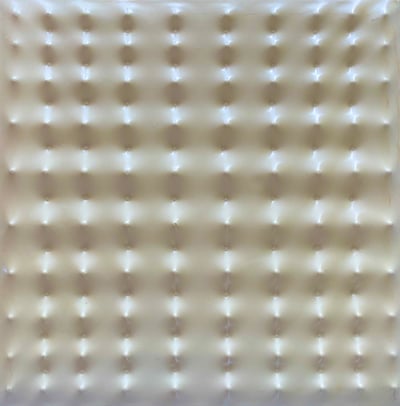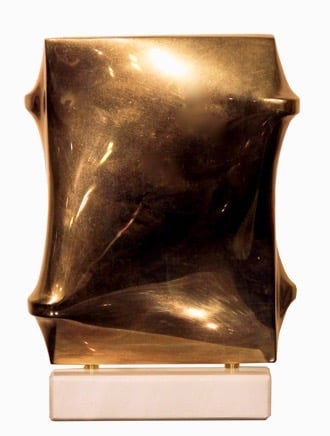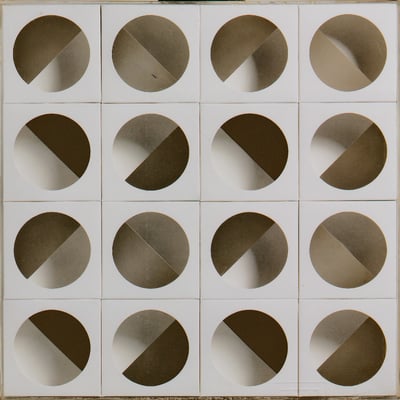
Litograph printed in red wih rips by Lucio Fontana, from the suite Corrente, edited by Teodorani, Milano. One of the 12 artist proofs printed out of the 150 exemplars of the edition, which were printed in purple. Pencil signed and denoted "prova d'artista".
Lucio Fontana (Argentina/Italy, 1899–1968) was a groundbreaking artist and founder of Spatialism. Known for his iconic Concetto Spaziale works, he pierced and slashed canvases to explore space, light, and materiality, revolutionizing the concept of painting as a medium.
LithographLithography is a printing method based on the principle that water and oil do not mix. It can be used to print artwork or text onto paper or other suitable materials. Traditionally, an image was drawn with wax, fat, or oil onto a lithographic limestone surface or plate. Today, metal plates and other surfaces are also used in lithographic printing.
Litograph printed in red wih rips by Lucio Fontana, from the suite Corrente, edited by Teodorani, Milano. One of the 12 artist proofs printed out of the 150 exemplars of the edition, which were printed in purple. Pencil signed and denoted "prova d'artista".
Lucio Fontana (Argentina/Italy, 1899–1968) was a groundbreaking artist and founder of Spatialism. Known for his iconic Concetto Spaziale works, he pierced and slashed canvases to explore space, light, and materiality, revolutionizing the concept of painting as a medium.
I do not want to make a painting; I want to open up space, create a new dimension, tie in the cosmos, as it endlessly expands beyond the confining plane of the picture.
- Lucio Fontana
Recognised as the founder of Spatialism, Lucio Fontana was a prolific artist who was driven by a desire to highlight and explore the relationship between surface and dimensionality. Fontana’s techniques included slicing through canvas and punching holes in the surface of his work – Spatial Concept is a series of works that exemplify this particular technique and Fontana would often line the reverse of his canvas with black gauze; the darkness would then shimmer through the holes he had created and further add to the illusory and mysterious effect. Fontana was also acclaimed for his use of a wide-range of materials; for a series of paintings created for the ‘Art and Contemplation’ exhibition, he manipulated the surface paint with his fingers and Murano glass. Inspired by his visit to New York City, Fontana also worked extensively with metal for several years – he used shiny copper sheets to scratch and gouge holes into the metal and the final results alluded to the burgeoning architecture of the city. (Artist website)
Abstract Expressionism is an art movement that emerged in the United States during the 1940s and 1950s. Characterized by large, abstract canvases, the movement emphasized spontaneous, expressive brushwork and the use of color and form to convey emotion rather than represent reality. Artists like Jackson Pollock, Mark Rothko, and Willem de Kooning are key figures in this movement. Abstract Expressionism marked a shift in the art world, making New York City a center of the international art scene.