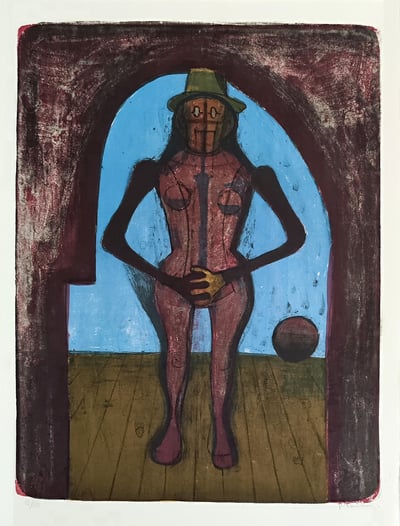
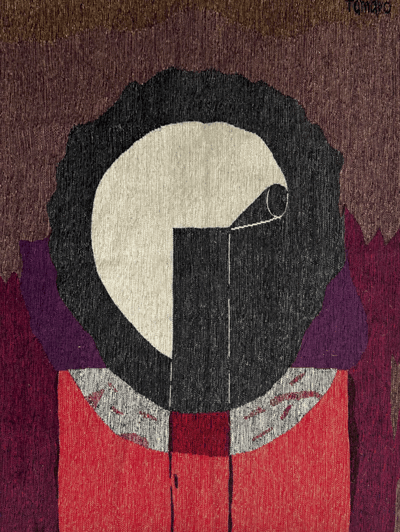
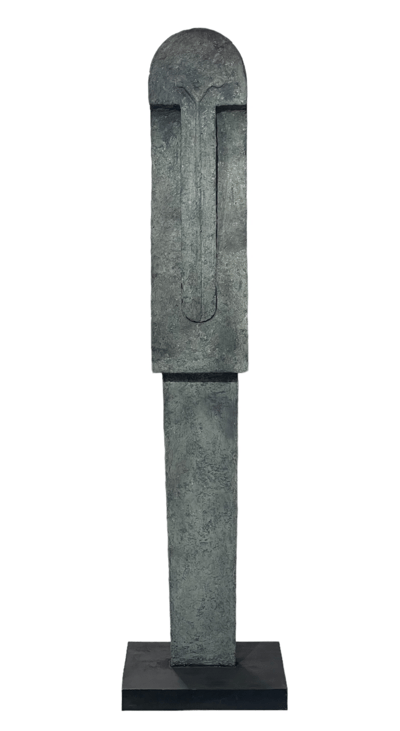
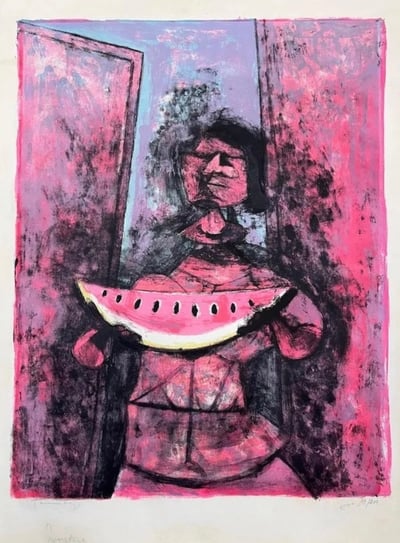
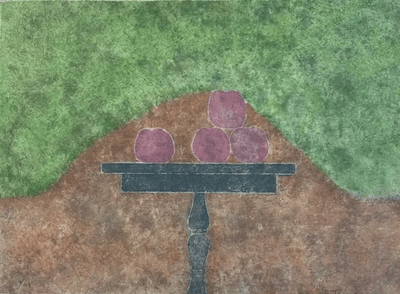
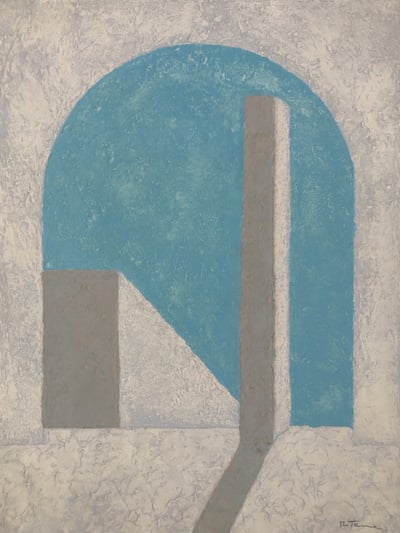
Catalogued in the book Rufino Tamayo, Catalogue Raisonné Gráfica / Prints 1925-1991.
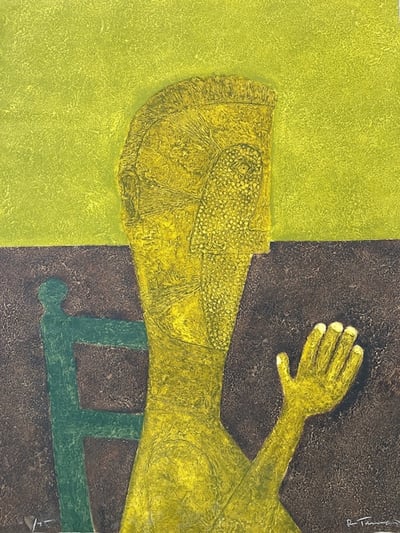
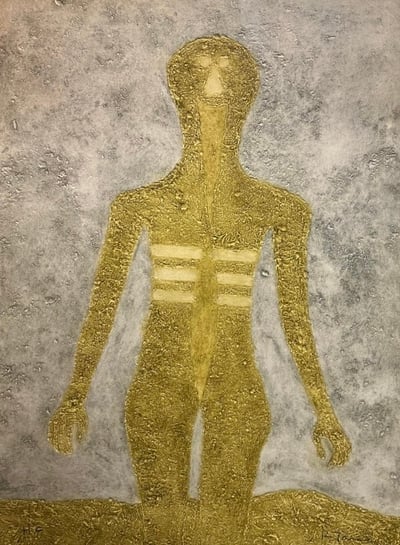
Rufino Tamayo’s Personaje sentado (Seated Figure, 1976) is an etching that exemplifies the artist’s distinctive fusion of modernist abstraction and symbolic figuration. The composition presents a solitary seated figure rendered in luminous yellow-green tones against a simplified background divided into fields of color. The elongated form, textured surface, and mask-like facial features lend the figure a timeless, almost archetypal presence. Rather than depicting a specific individual, Tamayo creates a universal image of human contemplation and existence. Throughout his career, the Mexican artist combined influences from pre-Columbian art, popular culture, and modern painting, developing a visual language that balances monumentality with intimacy. In Personaje sentado, the restrained composition and rich tonal contrasts evoke both stillness and psychological depth, hallmarks of Tamayo’s mature work.
Rufino Tamayo (Mexico, 1899–1991) blended modernism with Mexican heritage, creating bold, color-driven paintings and prints. Influenced by Zapotec culture, he avoided political narratives, focusing instead on universal themes and textured surfaces. His innovative use of color and form helped redefine 20th-century Mexican art beyond muralism.
EtchingEtching is a technique where a design is created on a metal surface by using a strong acid or mordant to eat away the unprotected parts of the metal, leaving the desired pattern in relief (intaglio). In modern art and manufacturing, different chemicals may be used depending on the material being etched.
Catalogued in the book Rufino Tamayo, Catalogue Raisonné Gráfica / Prints 1925-1991.
Rufino Tamayo’s Personaje sentado (Seated Figure, 1976) is an etching that exemplifies the artist’s distinctive fusion of modernist abstraction and symbolic figuration. The composition presents a solitary seated figure rendered in luminous yellow-green tones against a simplified background divided into fields of color. The elongated form, textured surface, and mask-like facial features lend the figure a timeless, almost archetypal presence. Rather than depicting a specific individual, Tamayo creates a universal image of human contemplation and existence. Throughout his career, the Mexican artist combined influences from pre-Columbian art, popular culture, and modern painting, developing a visual language that balances monumentality with intimacy. In Personaje sentado, the restrained composition and rich tonal contrasts evoke both stillness and psychological depth, hallmarks of Tamayo’s mature work.
Rufino Tamayo (Mexico, 1899–1991) blended modernism with Mexican heritage, creating bold, color-driven paintings and prints. Influenced by Zapotec culture, he avoided political narratives, focusing instead on universal themes and textured surfaces. His innovative use of color and form helped redefine 20th-century Mexican art beyond muralism.
Can you believe that, to say that ours is the only path when the fundamental thing in art is freedom! In art, there are millions of paths—as many paths as there are artists.
— Rufino Tamayo
Rufino Tamayo (b. 1899 Mexico, d. 1991 Mexico) was a painter and printmaker who forged a distinct path within 20th-century modern art. Blending elements of Mexican folk traditions with international modernism, his work resists overt political narratives in favor of universal themes such as humanity, cosmology, and existence. Tamayo is known for his rich color palettes, textured surfaces, and simplified, often monumental forms. Working across painting, mural, and graphic media, he developed innovative techniques, particularly in printmaking, where he helped popularize the mixografia process. Influenced by pre-Columbian art and European movements like Cubism, Tamayo created a visual language that feels both ancient and contemporary. His work situates him between cultural specificity and global abstraction, making him a key figure in redefining Mexican art beyond nationalist frameworks.
Cubism is an art movement that aimed to depict multiple perspectives of objects or figures within a single picture. Artists Georges Braque and Pablo Picasso pioneered this style around 1907. The name Cubism emerged from their use of geometric shapes and outlines that often resembled cubes, breaking objects down into abstracted forms.