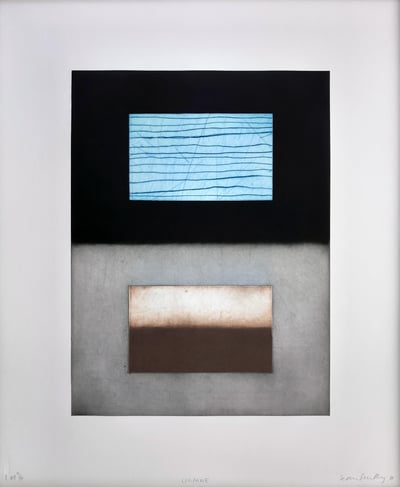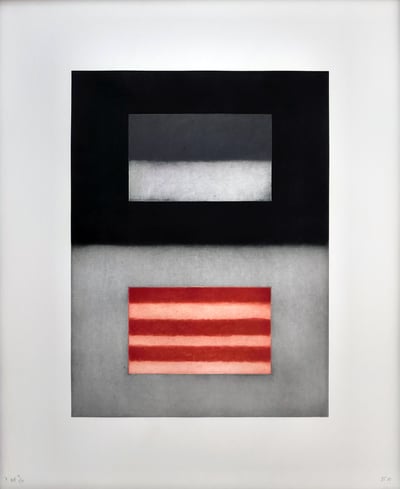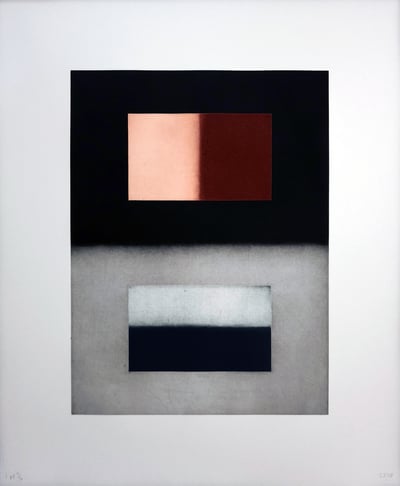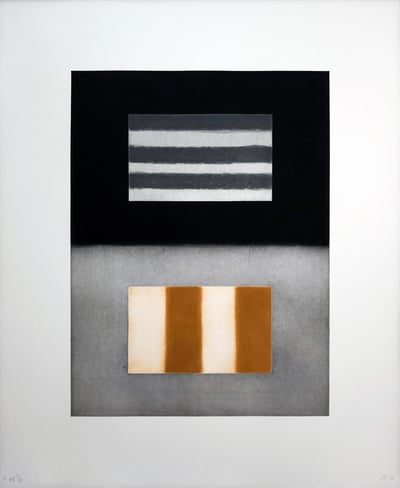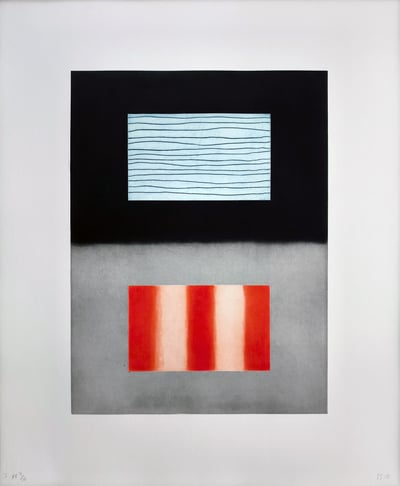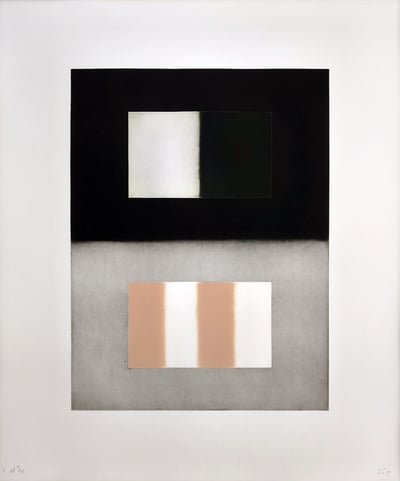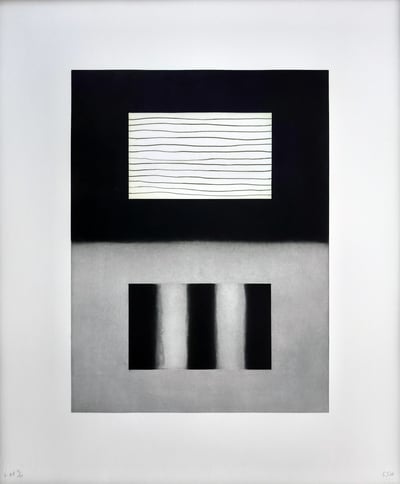
// Sean Scully's Liliane 5 is a minimalist yet evocative aquatint print that showcases the artist’s signature style of geometric abstraction. The composition is divided into two rectangular forms, one placed above the other. The top rectangle, split between warm peach and earthy brown tones, contrasts with the muted monochromatic rectangle below, which fades from light gray to deep black. The interaction between the contrasting colors and the soft transitions in tone create a sense of balance and depth, emphasizing Scully’s mastery of form and texture. The bold simplicity of the shapes invites viewers to reflect on the relationship between structure and emotion in abstract art. This limited edition print, signed and numbered, exemplifies Scully’s continued exploration of geometric forms and color fields.
Sean Scully (Ireland, 1945) is a contemporary artist renowned for his abstract paintings characterized by bold stripes and geometric forms. His work bridges Minimalism and Emotional Abstraction, emphasizing color and texture. Scully's art is featured in major institutions like MoMA and Tate Modern, reflecting his significant influence on modern abstraction.
AquatintIntaglio is a printmaking technique where the artist creates marks on a metal plate that hold ink or dye. The inked plate is then pressed onto paper, transferring the ink to the sheet. This process can be repeated multiple times depending on the technique. Intaglio methods, such as etching, often involve applying a mordant (acid) to the metal plate to create the design. Intaglio encompasses various techniques, including engraving, etching, and drypoint.
// Sean Scully's Liliane 5 is a minimalist yet evocative aquatint print that showcases the artist’s signature style of geometric abstraction. The composition is divided into two rectangular forms, one placed above the other. The top rectangle, split between warm peach and earthy brown tones, contrasts with the muted monochromatic rectangle below, which fades from light gray to deep black. The interaction between the contrasting colors and the soft transitions in tone create a sense of balance and depth, emphasizing Scully’s mastery of form and texture. The bold simplicity of the shapes invites viewers to reflect on the relationship between structure and emotion in abstract art. This limited edition print, signed and numbered, exemplifies Scully’s continued exploration of geometric forms and color fields.
Sean Scully (Ireland, 1945) is a contemporary artist renowned for his abstract paintings characterized by bold stripes and geometric forms. His work bridges Minimalism and Emotional Abstraction, emphasizing color and texture. Scully's art is featured in major institutions like MoMA and Tate Modern, reflecting his significant influence on modern abstraction.
When I got into art school, I thought it was paradise.
- Sean Scully
Widely acclaimed for his abstract oil paintings, Sean Scully is an artist whose works often combine geometric structures with contrasting soft edges and thick uneven surfaces to form alternating panels of coloured squares or stripes – such works as Green Ascending and Rouge perfectly exemplify his trademark style of painting. Although his abstract works appear to have no specific reference, Scully’s previous employment as a typesetter had a great bearing on his later artistic outputs, and of his Land Sea exhibition, Scully noted that his experience of visiting Venice was a major influence as he sought to recreate ‘the movement of the water, how it heaves against the brick and stone of the city’; the artist also noted that his earliest memory of art is of a series of devotional paintings on show at a local Catholic church where he grew up, commenting that they were ‘very geometric, like Russian paintings.’ (Artist website)
Lyrical abstraction is a descriptive term characterizing a type of abstract painting closely related to Abstract Expressionism, in use from the 1940s to the present. The term can also describe two distinct but related trends in post-World War II modernist painting. This art movement originated in Paris, France, after the war, emphasizing personal expression, spontaneity, and the emotional use of color and form.