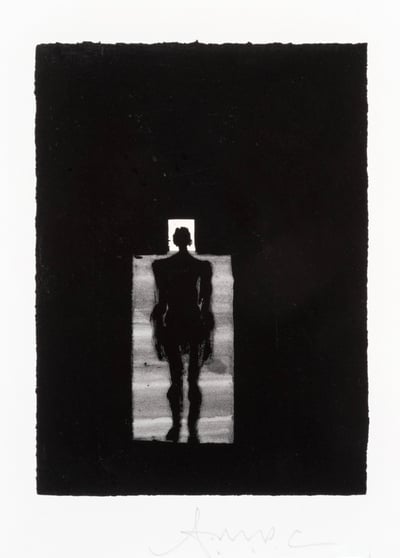
Photogravure etching on Fabriano Paper. Signed, titled, numbered and dated in pencil on the verso. Published by Ingleby Gallery.
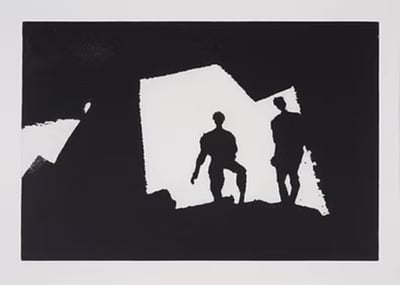
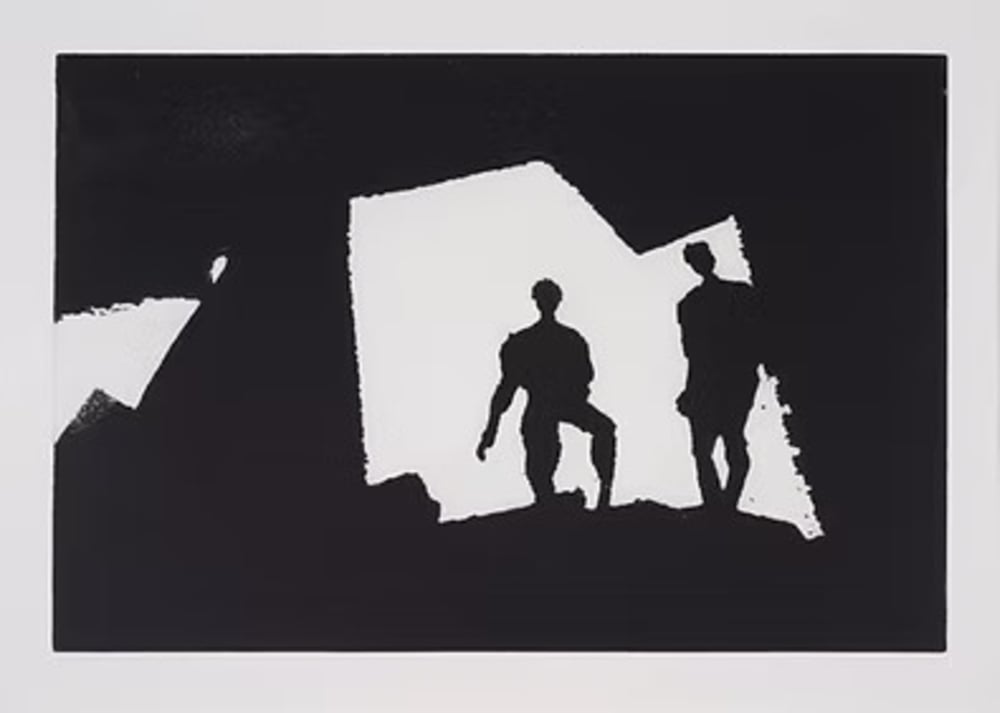
From The Cave is a photogravure etching by Antony Gormley that distils the artist's enduring preoccupation with the human body as a site of spatial and philosophical inquiry. Two silhouetted figures stand at the mouth of a cave, framed by dark surrounding rock against an irregular opening of brilliant white light. The stark high-contrast composition evokes Plato's allegory of the cave, positioning the viewer at the threshold between darkness and illumination, interior and exterior, the known and the unknown. Gormley renders this archetypal encounter with austere visual economy.
Antony Gormley (United Kingdom, 1950) is a British sculptor celebrated for his exploration of the human form and its relationship to space. Known for iconic works like Angel of the North and Another Place, Gormley often uses his own body as a template. His sculptures challenge perceptions of identity, presence, and the environment.
Mixed MediaMixed media refers to artwork that incorporates more than one medium within a single piece. Unlike multimedia art, which combines distinct forms of visual art and often includes elements like sound, video, or digital media, mixed media focuses on combining traditional art materials, such as paint, ink, and collage. Mixed media art allows artists to achieve a wide range of effects and textures by layering and blending different materials.
Photogravure etching on Fabriano Paper. Signed, titled, numbered and dated in pencil on the verso. Published by Ingleby Gallery.
From The Cave is a photogravure etching by Antony Gormley that distils the artist's enduring preoccupation with the human body as a site of spatial and philosophical inquiry. Two silhouetted figures stand at the mouth of a cave, framed by dark surrounding rock against an irregular opening of brilliant white light. The stark high-contrast composition evokes Plato's allegory of the cave, positioning the viewer at the threshold between darkness and illumination, interior and exterior, the known and the unknown. Gormley renders this archetypal encounter with austere visual economy.
Antony Gormley (United Kingdom, 1950) is a British sculptor celebrated for his exploration of the human form and its relationship to space. Known for iconic works like Angel of the North and Another Place, Gormley often uses his own body as a template. His sculptures challenge perceptions of identity, presence, and the environment.
I'm trying to make work that is reflective and is encouraging of reflection.
- Antony Gormley
As a sculptor, almost all of Antony Gormley’s works take the human body as its subject – many works make use of his own body, or that of his friends, as the basis for metal casts. Gormley has described his work as ‘an attempt to materialise the place at the other side of appearance where we all live’ - his Event Horizon piece featured 31 separate life-sized and anatomically correct casts of his body – four in iron and 27 in fiberglass – situated along the tops of buildings along London’s South Bank, and later installed around Madison Square in New York City; of these works, Gormley has stated that they may encourage individuals to ‘reassess their own position in the world’ and become aware of their ‘status of embedment’. Among other notable works is the Angel of The North, a public steel sculpture situated in Gateshead, United Kingdom – the sculpture measures at 66ft tall with wings measuring 177ft across. (Artist website)
Contemporary art refers to avant-garde or innovative art created in the recent past or present day. The exact starting point of contemporary art varies depending on the institution, often tied to the founding year of museums or galleries that showcase the style. Contemporary art is characterized by its focus on current ideas, diverse media, and the exploration of new concepts and techniques.