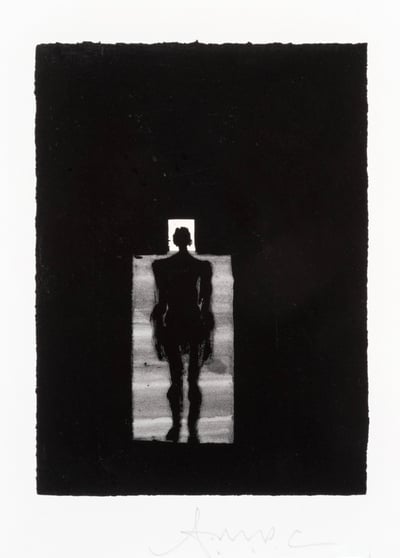
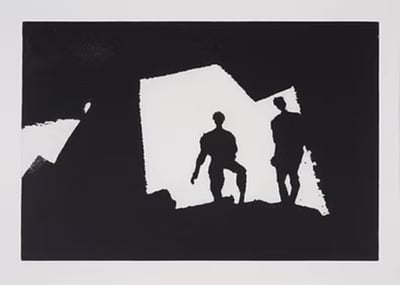
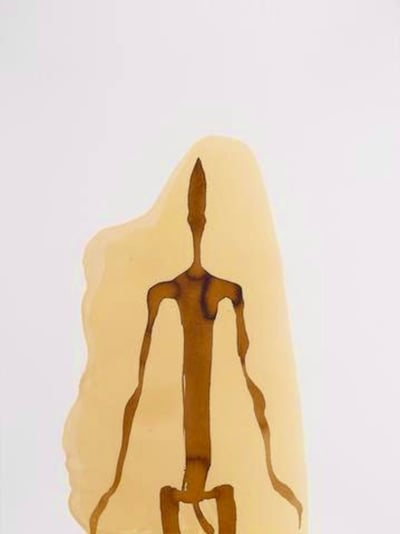
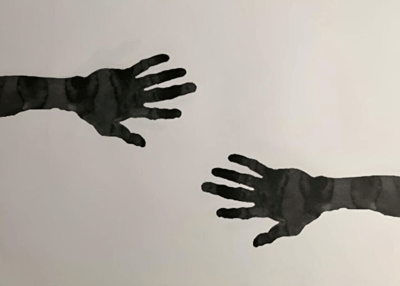
Four colour lithograph with screen-print glaze and hand poured varnish on Somerset Tub Sized Satin White 410gsm. -Produced by Counter Studio, Margate. -Signed, numbered and dated by the artist -Unframed
Antony Gormley's Free from 2019 is a limited edition lithograph that captures the raw energy and dynamism of the human form in motion. Set against a bold, organic orange shape, a silhouetted figure appears suspended or in free fall, creating a powerful sense of weightlessness and fluidity. The figure’s limbs extend outward, intersecting with fine lines that resemble a web, adding tension and complexity to the piece. Gormley’s use of four-color lithography, screen-print glaze, and hand-poured varnish on Somerset Tub Sized Satin White paper enhances the work’s textural quality and depth. The print evokes themes of freedom, constraint, and the exploration of physical space, emblematic of Gormley’s fascination with the body’s relationship to its environment.
Antony Gormley (United Kingdom, 1950) is a British sculptor celebrated for his exploration of the human form and its relationship to space. Known for iconic works like Angel of the North and Another Place, Gormley often uses his own body as a template. His sculptures challenge perceptions of identity, presence, and the environment.
Lithograph Lithography is a printing method based on the principle that water and oil do not mix. It can be used to print artwork or text onto paper or other suitable materials. Traditionally, an image was drawn with wax, fat, or oil onto a lithographic limestone surface or plate. Today, metal plates and other surfaces are also used in lithographic printing.
Four colour lithograph with screen-print glaze and hand poured varnish on Somerset Tub Sized Satin White 410gsm. -Produced by Counter Studio, Margate. -Signed, numbered and dated by the artist -Unframed
Antony Gormley's Free from 2019 is a limited edition lithograph that captures the raw energy and dynamism of the human form in motion. Set against a bold, organic orange shape, a silhouetted figure appears suspended or in free fall, creating a powerful sense of weightlessness and fluidity. The figure’s limbs extend outward, intersecting with fine lines that resemble a web, adding tension and complexity to the piece. Gormley’s use of four-color lithography, screen-print glaze, and hand-poured varnish on Somerset Tub Sized Satin White paper enhances the work’s textural quality and depth. The print evokes themes of freedom, constraint, and the exploration of physical space, emblematic of Gormley’s fascination with the body’s relationship to its environment.
Antony Gormley (United Kingdom, 1950) is a British sculptor celebrated for his exploration of the human form and its relationship to space. Known for iconic works like Angel of the North and Another Place, Gormley often uses his own body as a template. His sculptures challenge perceptions of identity, presence, and the environment.
I'm trying to make work that is reflective and is encouraging of reflection.
- Antony Gormley
As a sculptor, almost all of Antony Gormley’s works take the human body as its subject – many works make use of his own body, or that of his friends, as the basis for metal casts. Gormley has described his work as ‘an attempt to materialise the place at the other side of appearance where we all live’ - his Event Horizon piece featured 31 separate life-sized and anatomically correct casts of his body – four in iron and 27 in fiberglass – situated along the tops of buildings along London’s South Bank, and later installed around Madison Square in New York City; of these works, Gormley has stated that they may encourage individuals to ‘reassess their own position in the world’ and become aware of their ‘status of embedment’. Among other notable works is the Angel of The North, a public steel sculpture situated in Gateshead, United Kingdom – the sculpture measures at 66ft tall with wings measuring 177ft across. (Artist website)
Environmental art is a collective term that refers to a wide range of artistic practices and works that engage with historical and ecological themes. The term often encompasses ecological concerns, although it is not exclusively defined by them. Environmental art acknowledges and appreciates the early history of the environmental art movement, including works with activist themes and those celebrating the connection between nature and the artist through the use of natural materials.