

Literature: Schellman 92-96
Published by the artist, with the blindstamp of the printer, Styria Studio, New York, with full margins.
P 35 1/4 x 24 5/8in (89.5 x 62.5cm)
Sheet 39 7/8 x 29 3/8in (101.3 x 74.6cm).
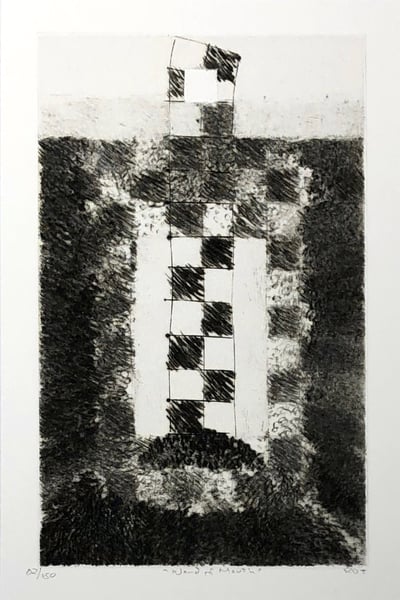
A Group of 4 Aquatints 1 (1978–79) by Donald Judd exemplifies the artist’s strict adherence to minimalism through pure geometric form and repetition. This aquatint presents a sequence of vertical black bars arranged in a slightly skewed parallelogram, emphasizing spatial rhythm and precision. The image, devoid of representational content, embodies Judd’s belief in the objecthood of art—artworks as autonomous entities. Published by Styria Studio, this piece is part of a significant suite that showcases Judd's commitment to form, clarity, and seriality.
Artwork Copyright © Donald JuddDonald Judd (USA, 1928–1994) was a pivotal figure in Minimalist art. Renowned for his geometric sculptures and installations, he emphasized industrial materials like steel, aluminum, and Plexiglas. Judd's work focused on spatial relationships and simplicity, rejecting traditional representation. His legacy includes the Chinati Foundation, preserving his vision in Marfa, Texas.
Artwork Copyright © Donald JuddA Group of 4 Aquatints 1, 1978-79
Form
Medium
Size
- Inches
- Centimeters
Edition
Price
Available works →
- Authenticity Guaranteed
- Insured Shipping
- Online Since 2005
●
●Inventory 15822
●Signed
●Comes with gallery invoice and certificate
●Sell Us a Similar Artwork. Learn more.
Literature: Schellman 92-96
Published by the artist, with the blindstamp of the printer, Styria Studio, New York, with full margins.
P 35 1/4 x 24 5/8in (89.5 x 62.5cm)
Sheet 39 7/8 x 29 3/8in (101.3 x 74.6cm).
A Group of 4 Aquatints 1 (1978–79) by Donald Judd exemplifies the artist’s strict adherence to minimalism through pure geometric form and repetition. This aquatint presents a sequence of vertical black bars arranged in a slightly skewed parallelogram, emphasizing spatial rhythm and precision. The image, devoid of representational content, embodies Judd’s belief in the objecthood of art—artworks as autonomous entities. Published by Styria Studio, this piece is part of a significant suite that showcases Judd's commitment to form, clarity, and seriality.
Artwork Copyright © Donald JuddDonald Judd (USA, 1928–1994) was a pivotal figure in Minimalist art. Renowned for his geometric sculptures and installations, he emphasized industrial materials like steel, aluminum, and Plexiglas. Judd's work focused on spatial relationships and simplicity, rejecting traditional representation. His legacy includes the Chinati Foundation, preserving his vision in Marfa, Texas.
Artwork Copyright © Donald Judd- Recently Added
- Price (Low-High)
- Price (High-Low)
- Year (Low-High)
- Year (High-Low)

Donald Judd
A Group of 4 Aquatints 1, 1978-79
Limited Edition Print
Aquatint
Currently Not Available
Donald Judd
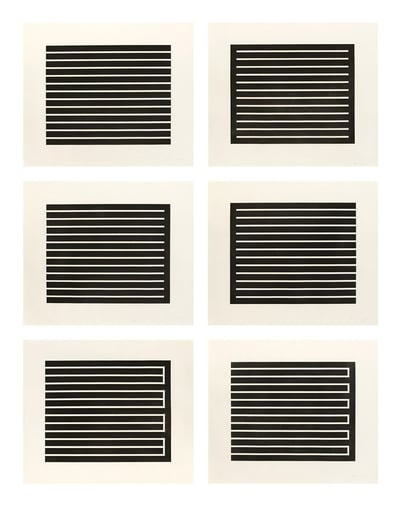
Untitled (set of 6), 1980
Limited Edition Print
Aquatint
Currently Not Available

Donald Judd
Untitled (from Kunstmarkt Köln), 1969
Limited Edition Print
Offset Print
Currently Not Available
Related Artists

Artwork by Frank Stella
Who are the American Abstract Artists (AAA) ?
American Abstract Artists (AAA) is an organization founded in New York City in 1936 to promote abstract art and its appreciation in the United States. At a time when abstract art faced strong opposition from critics, the AAA provided crucial exhibition opportunities for abstract artists, helping to foster the growth and acceptance of the movement.



