

Offset lithograph printed in black on heavy wove paper - With stamped signature and numbered in pencil - Published by Kunstmarkt Köln, Cologne
Untitled (from Kunstmarkt Köln) by Donald Judd is an offset lithograph created in 1969. The print features a minimalist arrangement of geometric forms—rectangular blocks stacked vertically with precise measurements noted alongside them. Judd's characteristic focus on clean lines and simplicity is evident, reflecting his commitment to minimalism and the importance of spatial relationships. The print is rendered in black ink on heavy wove paper, emphasizing the stark contrast and purity of form. Published by Kunstmarkt Köln, the work exemplifies Judd’s dedication to the reduction of art to its essential components.
Artwork Copyright © Donald JuddDonald Judd (USA, 1928–1994) was a pivotal figure in Minimalist art. Renowned for his geometric sculptures and installations, he emphasized industrial materials like steel, aluminum, and Plexiglas. Judd's work focused on spatial relationships and simplicity, rejecting traditional representation. His legacy includes the Chinati Foundation, preserving his vision in Marfa, Texas.
Artwork Copyright © Donald JuddUntitled (from Kunstmarkt Köln), 1969
Form
Medium
Size
- Inches
- Centimeters
Edition
Price
Available works →
- Authenticity Guaranteed
- Insured Shipping
- Online Since 2005
●
●Inventory 10889
●With stamped signature
●Comes with gallery invoice and certificate
●Sell Us a Similar Artwork. Learn more.
Offset lithograph printed in black on heavy wove paper - With stamped signature and numbered in pencil - Published by Kunstmarkt Köln, Cologne
Untitled (from Kunstmarkt Köln) by Donald Judd is an offset lithograph created in 1969. The print features a minimalist arrangement of geometric forms—rectangular blocks stacked vertically with precise measurements noted alongside them. Judd's characteristic focus on clean lines and simplicity is evident, reflecting his commitment to minimalism and the importance of spatial relationships. The print is rendered in black ink on heavy wove paper, emphasizing the stark contrast and purity of form. Published by Kunstmarkt Köln, the work exemplifies Judd’s dedication to the reduction of art to its essential components.
Artwork Copyright © Donald JuddDonald Judd (USA, 1928–1994) was a pivotal figure in Minimalist art. Renowned for his geometric sculptures and installations, he emphasized industrial materials like steel, aluminum, and Plexiglas. Judd's work focused on spatial relationships and simplicity, rejecting traditional representation. His legacy includes the Chinati Foundation, preserving his vision in Marfa, Texas.
Artwork Copyright © Donald Judd- Recently Added
- Price (Low-High)
- Price (High-Low)
- Year (Low-High)
- Year (High-Low)

Donald Judd
A Group of 4 Aquatints 1, 1978-79
Limited Edition Print
Aquatint
Currently Not Available
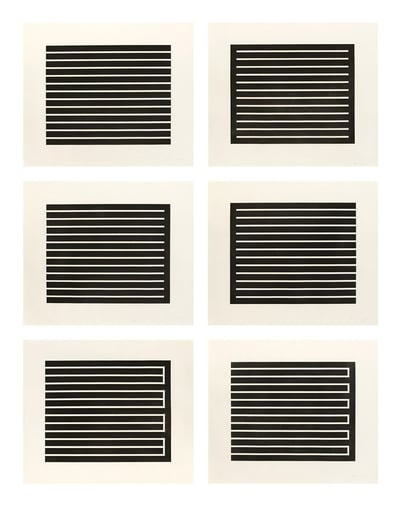
Donald Judd
Untitled (set of 6), 1980
Limited Edition Print
Aquatint
Currently Not Available

Donald Judd
Untitled (from Kunstmarkt Köln), 1969
Limited Edition Print
Offset Print
Currently Not Available
Related Artists
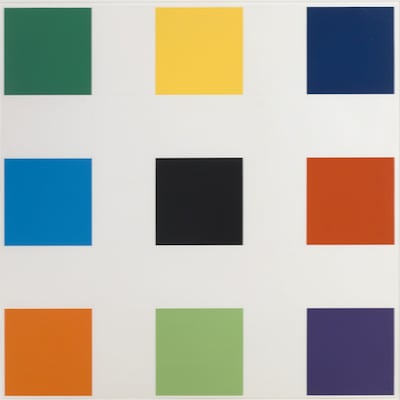
Artwork by Ellsworth Kelly
What is Hard Edge Art?
Hard Edge art is a style of abstract painting that became popular in the 1960s. It features areas of color separated by crisp, sharp edges that are painted with geometric precision. The term hard-edge painting was coined by art critic Jules Langsner to describe this approach, which contrasts with the softer, more fluid forms of other abstract styles.

Donald Judd
Untitled (from Kunstmarkt Köln), 1969
45 x 32 cm


