

Literature: Schellman 92-96
Published by the artist, with the blindstamp of the printer, Styria Studio, New York, with full margins.
P 35 1/4 x 24 5/8in (89.5 x 62.5cm)
Sheet 39 7/8 x 29 3/8in (101.3 x 74.6cm).
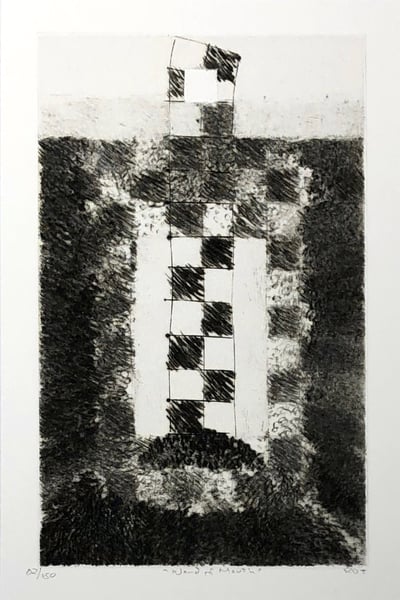
A Group of 4 Aquatints 4 (1978–79) by Donald Judd continues the artist’s rigorous exploration of minimalist form. This aquatint features two sets of parallel black bars enclosed within a shared skewed rectangular boundary. The visual rhythm is methodical, with the lower ends of the bars forming a mirrored U-shape pattern, introducing subtle complexity within strict repetition. Published by Styria Studio, this work reflects Judd’s philosophy of art as object—precise, impersonal, and focused on structure over expression.
Artwork Copyright © Donald JuddDonald Judd (USA, 1928–1994) was a pivotal figure in Minimalist art. Renowned for his geometric sculptures and installations, he emphasized industrial materials like steel, aluminum, and Plexiglas. Judd's work focused on spatial relationships and simplicity, rejecting traditional representation. His legacy includes the Chinati Foundation, preserving his vision in Marfa, Texas.
Artwork Copyright © Donald JuddA Group of 4 Aquatints 4, 1978-79
Form
Medium
Size
- Inches
- Centimeters
Edition
Price
Available works →
- Authenticity Guaranteed
- Insured Shipping
- Online Since 2005
●
●Inventory 15823
●Signed
●Comes with gallery invoice and certificate
●Sell Us a Similar Artwork. Learn more.
Literature: Schellman 92-96
Published by the artist, with the blindstamp of the printer, Styria Studio, New York, with full margins.
P 35 1/4 x 24 5/8in (89.5 x 62.5cm)
Sheet 39 7/8 x 29 3/8in (101.3 x 74.6cm).
A Group of 4 Aquatints 4 (1978–79) by Donald Judd continues the artist’s rigorous exploration of minimalist form. This aquatint features two sets of parallel black bars enclosed within a shared skewed rectangular boundary. The visual rhythm is methodical, with the lower ends of the bars forming a mirrored U-shape pattern, introducing subtle complexity within strict repetition. Published by Styria Studio, this work reflects Judd’s philosophy of art as object—precise, impersonal, and focused on structure over expression.
Artwork Copyright © Donald JuddDonald Judd (USA, 1928–1994) was a pivotal figure in Minimalist art. Renowned for his geometric sculptures and installations, he emphasized industrial materials like steel, aluminum, and Plexiglas. Judd's work focused on spatial relationships and simplicity, rejecting traditional representation. His legacy includes the Chinati Foundation, preserving his vision in Marfa, Texas.
Artwork Copyright © Donald Judd- Recently Added
- Price (Low-High)
- Price (High-Low)
- Year (Low-High)
- Year (High-Low)

Donald Judd
A Group of 4 Aquatints 1, 1978-79
Limited Edition Print
Aquatint
Currently Not Available
Donald Judd
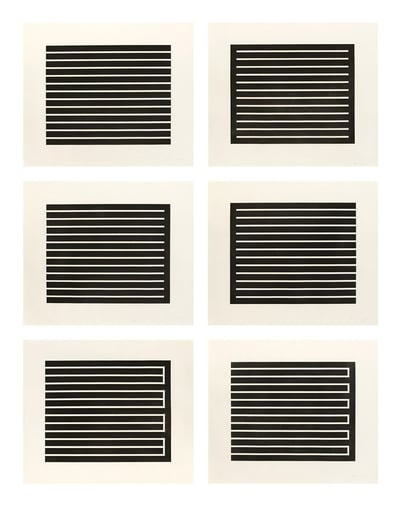
Untitled (set of 6), 1980
Limited Edition Print
Aquatint
Currently Not Available

Donald Judd
Untitled (from Kunstmarkt Köln), 1969
Limited Edition Print
Offset Print
Currently Not Available
Related Artists

Artwork by Christo
What is site specific art?
Site-Specific Art is a form of artwork created to exist in a particular location, with the artist considering the site as an integral part of the creative process. Robert Irwin was a key figure in promoting this art form in California. Site-Specific Art emerged as a reaction against modernist objects, which were often portable, commodified, and confined to museum spaces. In contrast, Site-Specific Art is inherently tied to its location, challenging the traditional notions of art as a transportable and marketable commodity.


