

Literature: Schellman 92-96
The incomplete set, comprising four aquatints (of 15) on wove paper.
Each signed in pencil.
Published by the artist, each with the blindstamp of the printer, Styria Studio, New York, with full margins.
Each plate 35 1/4 x 24 5/8in (89.5 x 62.5cm)
Each sheet 39 7/8 x 29 3/8in (101.3 x 74.6cm).
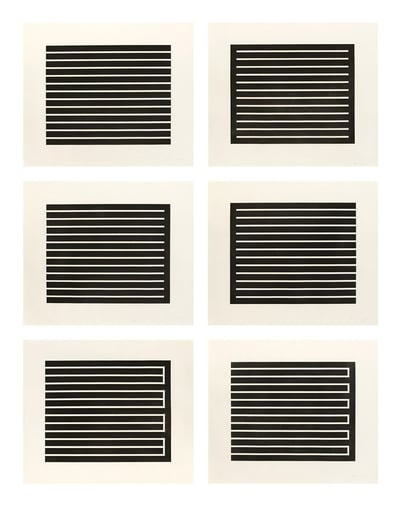
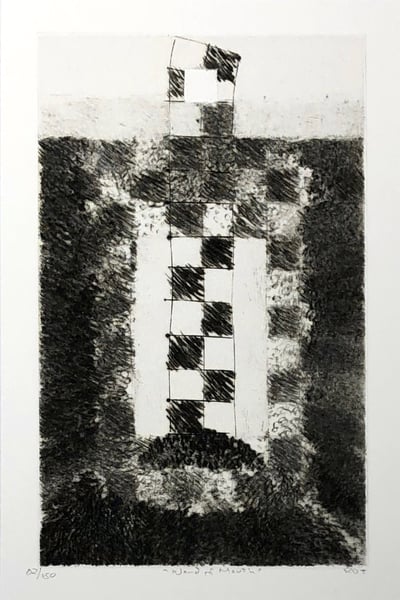
This group of four aquatints from Donald Judd's 1978–79 series (Schellman 92–96) exemplifies his rigorous approach to minimalism and systematic variation. Each print features geometric black forms—vertical lines forming rectilinear enclosures—set against expansive white paper. While appearing uniform at first glance, subtle differences in composition, spacing, and density create rhythmic variation and a sense of depth. Judd's use of aquatint gives the black fields a velvety, saturated texture, emphasizing material presence and precision. Printed at Styria Studio in New York, this incomplete set reflects Judd's concern with modularity and repetition in both two- and three-dimensional formats.
Artwork Copyright © Donald JuddDonald Judd (USA, 1928–1994) was a pivotal figure in Minimalist art. Renowned for his geometric sculptures and installations, he emphasized industrial materials like steel, aluminum, and Plexiglas. Judd's work focused on spatial relationships and simplicity, rejecting traditional representation. His legacy includes the Chinati Foundation, preserving his vision in Marfa, Texas.
Artwork Copyright © Donald JuddA Group of 4 Aquatints, 1978-79
Form
Medium
Size
- Inches
- Centimeters
Edition
Price
Available works →
- Authenticity Guaranteed
- Insured Shipping
- Online Since 2005
●
●Inventory 15695
●Signed
●Comes with gallery invoice and certificate
●Sell Us a Similar Artwork. Learn more.
Literature: Schellman 92-96
The incomplete set, comprising four aquatints (of 15) on wove paper.
Each signed in pencil.
Published by the artist, each with the blindstamp of the printer, Styria Studio, New York, with full margins.
Each plate 35 1/4 x 24 5/8in (89.5 x 62.5cm)
Each sheet 39 7/8 x 29 3/8in (101.3 x 74.6cm).
This group of four aquatints from Donald Judd's 1978–79 series (Schellman 92–96) exemplifies his rigorous approach to minimalism and systematic variation. Each print features geometric black forms—vertical lines forming rectilinear enclosures—set against expansive white paper. While appearing uniform at first glance, subtle differences in composition, spacing, and density create rhythmic variation and a sense of depth. Judd's use of aquatint gives the black fields a velvety, saturated texture, emphasizing material presence and precision. Printed at Styria Studio in New York, this incomplete set reflects Judd's concern with modularity and repetition in both two- and three-dimensional formats.
Artwork Copyright © Donald JuddDonald Judd (USA, 1928–1994) was a pivotal figure in Minimalist art. Renowned for his geometric sculptures and installations, he emphasized industrial materials like steel, aluminum, and Plexiglas. Judd's work focused on spatial relationships and simplicity, rejecting traditional representation. His legacy includes the Chinati Foundation, preserving his vision in Marfa, Texas.
Artwork Copyright © Donald Judd- Recently Added
- Price (Low-High)
- Price (High-Low)
- Year (Low-High)
- Year (High-Low)

Donald Judd
A Group of 4 Aquatints 1, 1978-79
Limited Edition Print
Aquatint
Currently Not Available
Donald Judd
Untitled (set of 6), 1980
Limited Edition Print
Aquatint
Currently Not Available

Donald Judd
Untitled (from Kunstmarkt Köln), 1969
Limited Edition Print
Offset Print
Currently Not Available
Related Artists
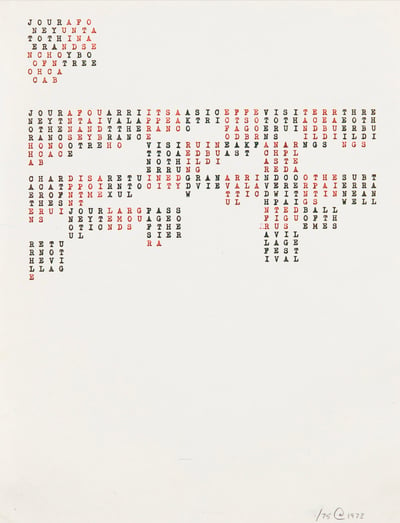
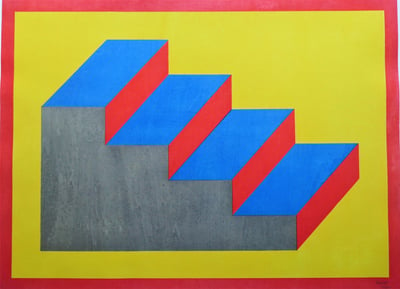
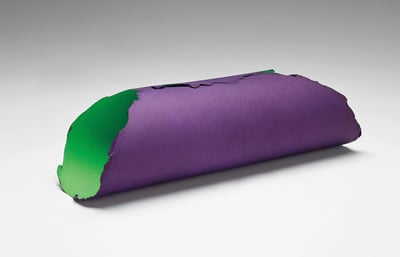

Artwork by Sol LeWitt
What is Generative Art?
Generative art refers to art that is wholly or partly created through an autonomous system. This system can be independent or non-human, capable of determining features that would otherwise be decided by the artist. The generative system can act as the creator or as a collaborator with the artist. Generative art often refers to works generated algorithmically by computers, where the system plays a significant role in the creation process.


