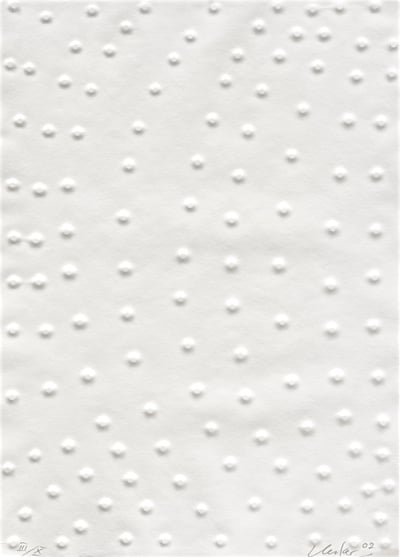
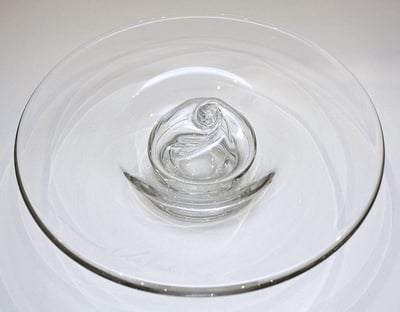
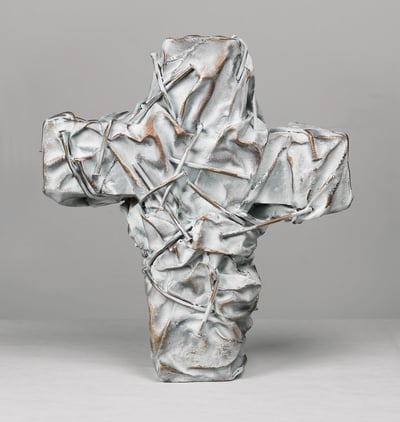
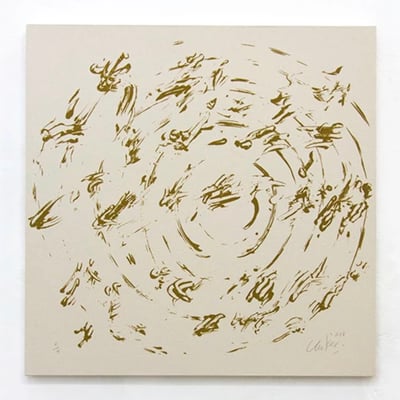
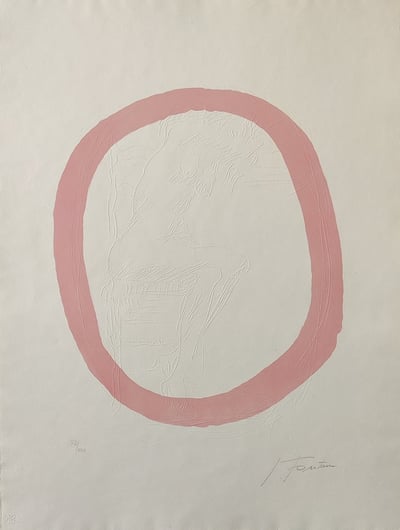
Embossed prints, on Eskulan paper, with accompanying text sheet.
Signed, dated, and numbered.
Co-published by Dorothea van der Koelen, Mainz and Edouard Weiss, Paris.
Literature: Van der Koelen, Dorothea and Martin (eds.): Günther Uecker - Opus Liber, Directory of Bibliophile Books and Works, Mainz 2007, Cat. No. L 0203, ill. pp. 507-511.
Graphein VII, Reise Kadmos (2002) by Günther Uecker is an elegant embossed print that forms part of his contemplative Graphein series, created on handmade Eskulan paper. This work features a series of arcing, wave-like rows of raised dots that traverse the composition in gentle curves. The title, Journey of Kadmos, references the mythological founder of Thebes, suggesting themes of exploration, destiny, and cultural origin—qualities echoed in the quiet rhythm and texture of the print. Uecker abstains from using ink or pigment, relying instead on the tactile language of embossing, where light and shadow become the primary visual elements. The subtle gradations and spacing of the dots suggest tides, sediment layers, or perhaps topographical echoes of a mythic path. It invites viewers into a meditative space, emphasizing sensory perception and introspection. Co-published by Dorothea van der Koelen in Mainz and Edouard Weiss in Paris, the edition is limited to 120 plus additional artist’s copies, highlighting Uecker’s continued pursuit of spiritual and material depth through minimalist means.
Gunther Uecker (Germany, 1930) is a key figure in the ZERO movement. Known for his nail-covered sculptures and reliefs, he explores light, shadow, and texture in dynamic ways. His works, often interactive, reflect themes of nature, rhythm, and spirituality, making him one of Germany’s most innovative postwar artists.
EmbossingEmbossing is a technique used to create raised designs or images on a surface, typically paper. Artists achieve this effect by altering the shape of the paper, often by pressing it from the reverse side using a template and a tool like a sanded dowel. The result is a design with multiple levels of depth, giving a three-dimensional appearance.
Embossed prints, on Eskulan paper, with accompanying text sheet.
Signed, dated, and numbered.
Co-published by Dorothea van der Koelen, Mainz and Edouard Weiss, Paris.
Literature: Van der Koelen, Dorothea and Martin (eds.): Günther Uecker - Opus Liber, Directory of Bibliophile Books and Works, Mainz 2007, Cat. No. L 0203, ill. pp. 507-511.
Graphein VII, Reise Kadmos (2002) by Günther Uecker is an elegant embossed print that forms part of his contemplative Graphein series, created on handmade Eskulan paper. This work features a series of arcing, wave-like rows of raised dots that traverse the composition in gentle curves. The title, Journey of Kadmos, references the mythological founder of Thebes, suggesting themes of exploration, destiny, and cultural origin—qualities echoed in the quiet rhythm and texture of the print. Uecker abstains from using ink or pigment, relying instead on the tactile language of embossing, where light and shadow become the primary visual elements. The subtle gradations and spacing of the dots suggest tides, sediment layers, or perhaps topographical echoes of a mythic path. It invites viewers into a meditative space, emphasizing sensory perception and introspection. Co-published by Dorothea van der Koelen in Mainz and Edouard Weiss in Paris, the edition is limited to 120 plus additional artist’s copies, highlighting Uecker’s continued pursuit of spiritual and material depth through minimalist means.
Gunther Uecker (Germany, 1930) is a key figure in the ZERO movement. Known for his nail-covered sculptures and reliefs, he explores light, shadow, and texture in dynamic ways. His works, often interactive, reflect themes of nature, rhythm, and spirituality, making him one of Germany’s most innovative postwar artists.
It’s about…creating… an instrument with which we can eat art.
- Gunther Uecker
Gunther Uecker (b. 1930, Germany) is a German artist renowned for his innovative contributions to kinetic art and Op art. He is best known as a key member of the ZERO group, a collective of artists who sought to redefine art in the aftermath of World War II. Uecker's work is characterized by his use of nails as a primary medium, creating dynamic, textured surfaces that interact with light and shadow. These nail-reliefs are both tactile and visually striking, embodying a sense of movement and energy. His explorations of light, shadow, and surface texture have made him a significant figure in post-war European art. Uecker's work has been exhibited in major museums around the world, including the Solomon R. Guggenheim Museum in New York and the Centre Pompidou in Paris.
A found object is a term used to describe a man-made or natural object, or a fragment of one, that an artist discovers or purchases and keeps for inspiration or as a work of art. The artist may also modify the object or incorporate it into a collage or assemblage, transforming it into a new piece of art.