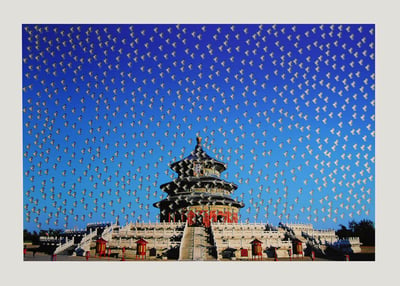
Gilclee, with silkscreen overlay, printed on 490 gram smooth custom paper
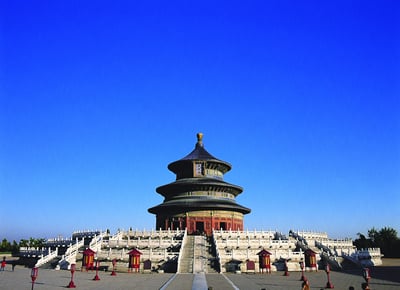
Huang Yan’s Temple of Heaven is a vibrant giclée print that captures the renowned architectural beauty of the Temple of Heaven in Beijing, while adding a surreal and layered visual effect. The traditional structure stands prominently against a striking blue sky, overlaid with hundreds of small, repeating bird silhouettes that appear to form a patterned sky. This unique combination of digital and silkscreen techniques brings together elements of nature and architecture, bridging historical and modern artistic approaches. The birds symbolize freedom and harmony with nature, contrasting with the grounded, ancient temple, thus creating a dialogue between the natural and built environments. Limited to an edition of 200, this work encapsulates Yan’s ability to reinterpret Chinese heritage with a contemporary vision.
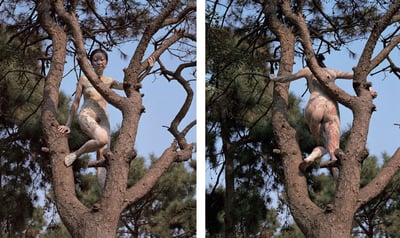
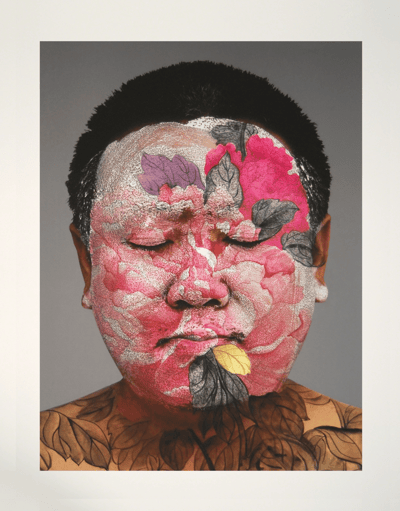
Huang Yan (China, 1966) merges traditional Chinese art with contemporary mediums, famously painting landscapes on human bodies. His innovative works, such as the Chinese Landscape Tattoo series, explore themes of identity, nature, and cultural heritage, blending ancient aesthetics with modern artistic expressions. Huang’s art bridges the past and present, symbolizing a living connection to tradition.
mixed mediaGiclée printing is a digital technique for reproducing artwork using a high-resolution digital file and an inkjet printer with archival-quality inks. This process produces prints with exceptional color accuracy and detail, closely matching the original artwork.
Gilclee, with silkscreen overlay, printed on 490 gram smooth custom paper
Huang Yan’s Temple of Heaven is a vibrant giclée print that captures the renowned architectural beauty of the Temple of Heaven in Beijing, while adding a surreal and layered visual effect. The traditional structure stands prominently against a striking blue sky, overlaid with hundreds of small, repeating bird silhouettes that appear to form a patterned sky. This unique combination of digital and silkscreen techniques brings together elements of nature and architecture, bridging historical and modern artistic approaches. The birds symbolize freedom and harmony with nature, contrasting with the grounded, ancient temple, thus creating a dialogue between the natural and built environments. Limited to an edition of 200, this work encapsulates Yan’s ability to reinterpret Chinese heritage with a contemporary vision.
Huang Yan (China, 1966) merges traditional Chinese art with contemporary mediums, famously painting landscapes on human bodies. His innovative works, such as the Chinese Landscape Tattoo series, explore themes of identity, nature, and cultural heritage, blending ancient aesthetics with modern artistic expressions. Huang’s art bridges the past and present, symbolizing a living connection to tradition.
The body is not just a surface; it holds our history and culture. To paint on it is to rewrite those stories.
- Huang Yan
Huang Yan is a contemporary multimedia artist from Beijing, China. He currently lectures at Changchun University. He combines painting, photography and sculpture to create his artwork. Yan is most famous for using human beings as canvas, painting landscapes, patterns and flowers on people's faces and bodies. The photographs of the painted people becomes the artwork. Much of his landscape paintings are influenced by the Song dynasty and he also uses zen and Buddhist themes in his work. One of the most famous artists in China today, Mr. Huang who started out as a poet, has had exhibitions of his work all over the world. His biggest controversy came in 2014, when his porcelain busts of Mao weren't allowed to leave China for an exhibition in France. The busts were considered to be disrespectful to the deceased communist leader. Huang Yan is also a businessman and author. He operates his own art gallery, Must Be Contemporary Art, and writes mostly about fellow contemporary Chinese artists. His wife, Zhang Tiemei, is also an artist and they often work together.
Appropriation in art involves using pre-existing images or objects with little or no modification. This technique has played a significant role across various art forms, including visual arts, music, performance, and literature. In visual arts, appropriation refers to the practice of adopting, sampling, recycling, or borrowing elements—or even entire forms—of existing visual culture, integrating them into new works to create meaning or critique.