Color Etchings and Aquatints, on Somerset
- Signed, Numbered and Dated
- Published by the Brooklyn Academy of Music, New York
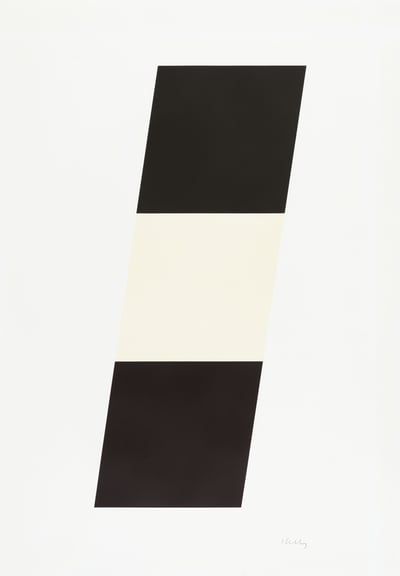
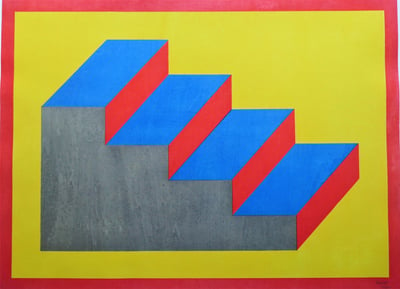
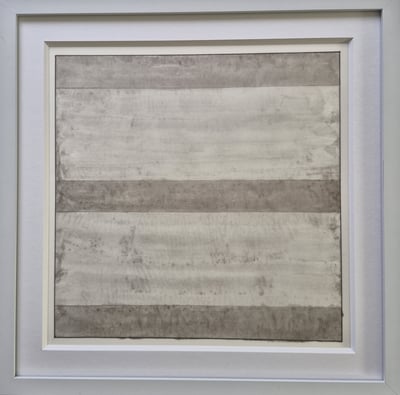
Robert Mangold's Untitled, State A (color) (1988) is a limited edition etching and aquatint on Somerset paper that exemplifies his minimalist aesthetic. The artwork features two geometric forms: an elongated oval on the left and an open ellipse on the right, both set within angular, translucent shapes. The use of soft, subtle shades creates a delicate balance between line and form, evoking a sense of quiet harmony. The precision and simplicity of the piece reflect Mangold’s exploration of spatial relationships and the interplay between structure and transparency. Published by the Brooklyn Academy of Music, this piece is signed, dated, and numbered by the artist.
Robert Mangold (United States, 1937) is a minimalist artist renowned for his geometric abstractions that explore the interplay of shape, line, and color. His work often features subtle color palettes and hand-drawn graphite lines, creating a harmonious balance between form and space. Mangold's paintings and prints have been exhibited internationally, influencing contemporary abstract art.
Etching and AquatintEtching and aquatint are printmaking techniques. In aquatint, the printing plate is etched with a pattern of tiny pits and cracks to create a wide range of tonal gradations. This technique allows artists to replicate the broad, flat tones found in watercolor paintings and ink washes.
Color Etchings and Aquatints, on Somerset
- Signed, Numbered and Dated
- Published by the Brooklyn Academy of Music, New York
Robert Mangold's Untitled, State A (color) (1988) is a limited edition etching and aquatint on Somerset paper that exemplifies his minimalist aesthetic. The artwork features two geometric forms: an elongated oval on the left and an open ellipse on the right, both set within angular, translucent shapes. The use of soft, subtle shades creates a delicate balance between line and form, evoking a sense of quiet harmony. The precision and simplicity of the piece reflect Mangold’s exploration of spatial relationships and the interplay between structure and transparency. Published by the Brooklyn Academy of Music, this piece is signed, dated, and numbered by the artist.
Robert Mangold (United States, 1937) is a minimalist artist renowned for his geometric abstractions that explore the interplay of shape, line, and color. His work often features subtle color palettes and hand-drawn graphite lines, creating a harmonious balance between form and space. Mangold's paintings and prints have been exhibited internationally, influencing contemporary abstract art.
Art feeds off art...and artists feed off artists.
- Robert Mangold
Robert Mangold is a minimalist artist from New York who primarily uses acrylic and pencil on canvas. Minimalism is an art form that started in New York during the 1950s that is known for its simplicity and is devoid of any personal expression from the artist. Robert Mangold initially received his art training at the Cleveland Institute of Art from 1956-1959 in Ohio before transferring to Yale University where he received a BFA (’61) and MFA (’63). Robert Mangold is known for painting shapes such as rings, columns, crosses and trapezoids and will overlap multiple shapes on a single piece of work. As a minimalist, he focuses on taking various architectural forms and reduces them to their basic elements and shapes while using a monochromatic color scheme. A couple of other notable minimalist artists include Donald Judd and Frank Stella. Robert Mangold’s art is a reflection of a time and place where the minimalist movement began.
Hard Edge art is a style of abstract painting that became popular in the 1960s. It features areas of color separated by crisp, sharp edges that are painted with geometric precision. The term hard-edge painting was coined by art critic Jules Langsner to describe this approach, which contrasts with the softer, more fluid forms of other abstract styles.