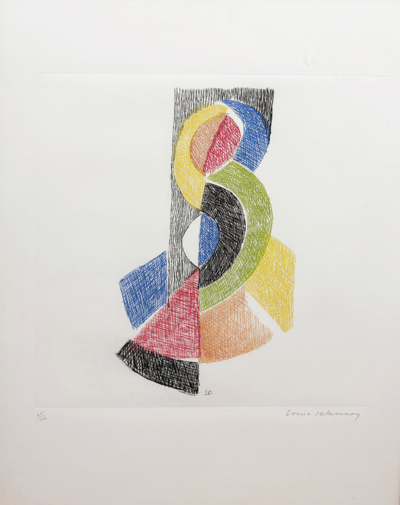
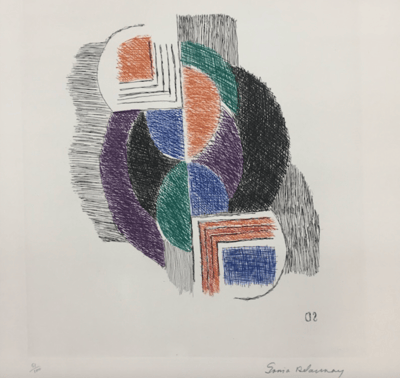
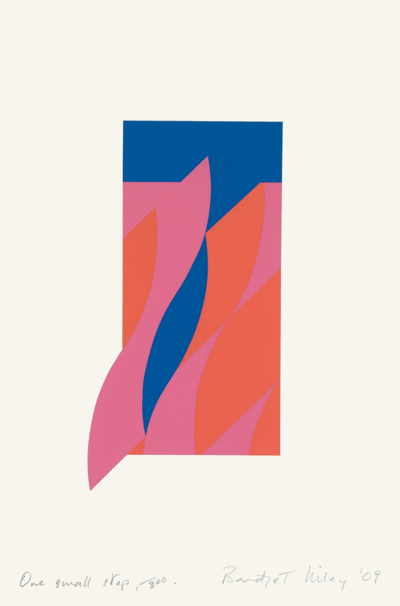
Courbe Verte exemplifies Sonia Delaunay at the apex of her lifelong investigation into the dynamic properties of colour and form, a late masterwork that distils eight decades of artistic innovation into a single luminous composition. A bold arcing green curve sweeps across the lithographic stone with gestural confidence, creating a sense of movement and rhythmic propulsion, while overlapping geometric circles rendered in vibrant orange, blue, red, and grey activate the darker navy and black background with a symphony of chromatic simultaneity. Delaunay was the pioneer of Orphism — that efflorescence of pure abstraction emerging from Cubism — which celebrated colour's capacity to function as an independent expressive force, liberated from the necessity of describing three-dimensional form or representing recognisable subject matter. In this late work, the artist demonstrates undiminished mastery of colour relationship and harmonic balance. The sweeping curve becomes almost architectural in its monumentality, a spatial armature upon which the coloured forms dance and resonate. The lithograph format, with its capacity to achieve subtle tonal modulation and gestural mark-making, proves perfect for Delaunay's expressive intent. This edition of 25 impressions represents work from the final flowering of her career, executed when she was over ninety years old, and it testifies to an astonishing constancy of vision and technical accomplishment. Courbe Verte is both a summation and a testament: it gathers the experiential wisdom of a lifetime devoted to understanding colour's infinite expressivity into a work of rare poetic economy.
Sonia Delaunay (Ukraine/France, 1885–1979) was a pioneering artist and designer, celebrated for her vibrant abstract works and use of color. A key figure in the Orphism movement, she applied her innovative style to painting, textiles, and fashion. Delaunay’s legacy bridges fine art and design, influencing modern aesthetics profoundly.
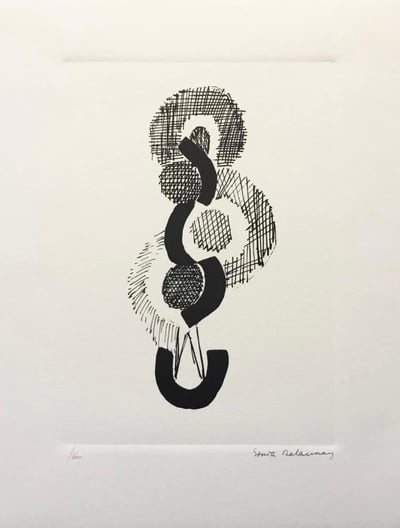
Lithograph Lithography is a printing method based on the principle that water and oil do not mix. It can be used to print artwork or text onto paper or other suitable materials. Traditionally, an image was drawn with wax, fat, or oil onto a lithographic limestone surface or plate. Today, metal plates and other surfaces are also used in lithographic printing.
Courbe Verte exemplifies Sonia Delaunay at the apex of her lifelong investigation into the dynamic properties of colour and form, a late masterwork that distils eight decades of artistic innovation into a single luminous composition. A bold arcing green curve sweeps across the lithographic stone with gestural confidence, creating a sense of movement and rhythmic propulsion, while overlapping geometric circles rendered in vibrant orange, blue, red, and grey activate the darker navy and black background with a symphony of chromatic simultaneity. Delaunay was the pioneer of Orphism — that efflorescence of pure abstraction emerging from Cubism — which celebrated colour's capacity to function as an independent expressive force, liberated from the necessity of describing three-dimensional form or representing recognisable subject matter. In this late work, the artist demonstrates undiminished mastery of colour relationship and harmonic balance. The sweeping curve becomes almost architectural in its monumentality, a spatial armature upon which the coloured forms dance and resonate. The lithograph format, with its capacity to achieve subtle tonal modulation and gestural mark-making, proves perfect for Delaunay's expressive intent. This edition of 25 impressions represents work from the final flowering of her career, executed when she was over ninety years old, and it testifies to an astonishing constancy of vision and technical accomplishment. Courbe Verte is both a summation and a testament: it gathers the experiential wisdom of a lifetime devoted to understanding colour's infinite expressivity into a work of rare poetic economy.
Sonia Delaunay (Ukraine/France, 1885–1979) was a pioneering artist and designer, celebrated for her vibrant abstract works and use of color. A key figure in the Orphism movement, she applied her innovative style to painting, textiles, and fashion. Delaunay’s legacy bridges fine art and design, influencing modern aesthetics profoundly.
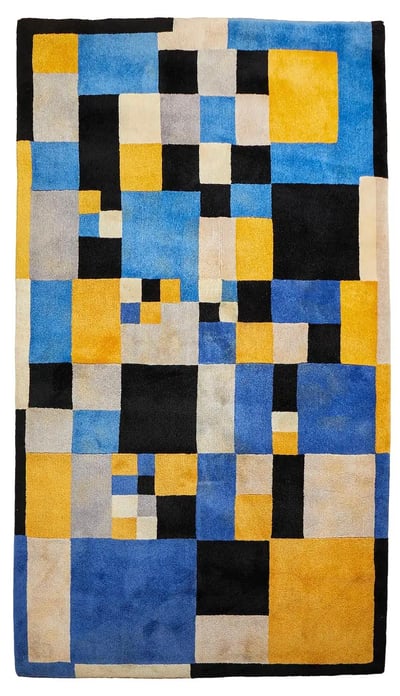
Sonia Delaunay was a French artist who helped found France's Orphism art movement. This particular style makes use of geometric figures and bold colors. She was a painter who also delved into textile and stage set design, and was known for employing geometric abstraction in her work. This is exemplified in "Rythme", an oil painting created by Delaunay in 1938 that features circles and curves of vibrant color. Delaunay often collaborated with her husband, artist Robert Delaunay, and they shared a similar style of painting. They both worked on decorating the pavilions at the Exposition Internationale des Arts et Techniques dans la Vie Moderne in 1937. In addition to her paintings, Delaunay designed a range of fabrics, wall coverings, furniture, and clothing. Much like her paintings, Sonia's textiles and modern design pieces featured geometric abstraction. In 1964, Sonia Delaunay became the first woman to have her work shown at a retrospective exhibition at the Louvre while still living. She received the privilege of being named an officer of France's Legion of Honor in 1975.
Futurism was an early 20th-century art movement that sought to capture the energy and dynamism of the modern world. The movement was launched by Italian poet Filippo Tommaso Marinetti, who published the Manifesto of Futurism on February 20, 1909. Futurism denounced the past and passionately embraced technology, industry, and the speed of modern life.