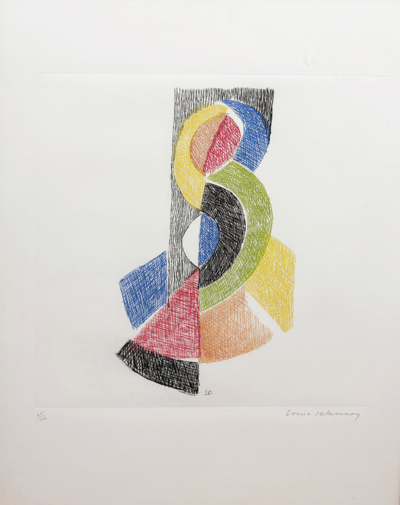
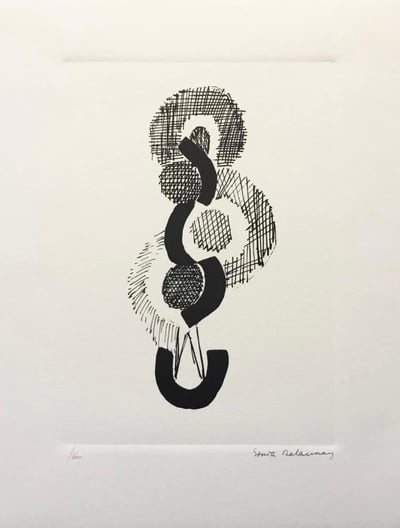
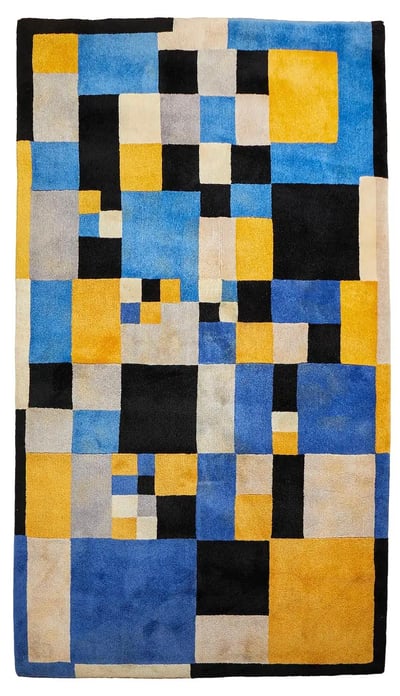
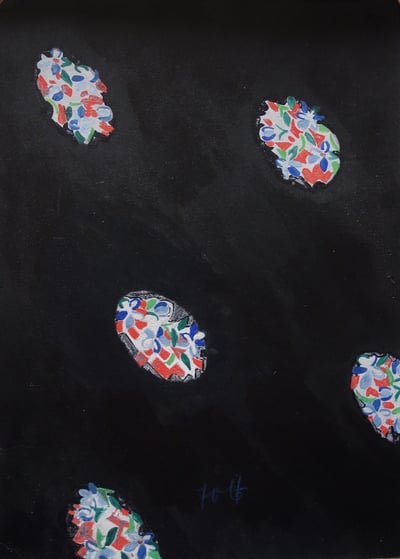
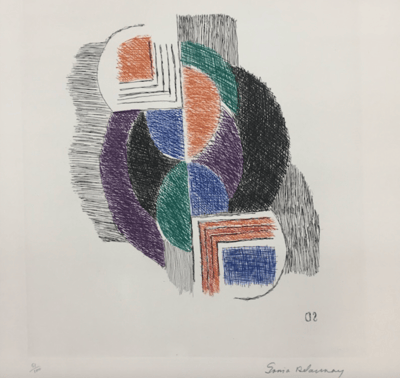
Delaunay's 'Simultanism' finds perfect expression in this glazed Limoges porcelain plate, where vibrant concentric colour fields pulse with optical energy. The work demonstrates her revolutionary approach to colour relationships, where hues vibrate in proximity to generate new perceptual experiences. Published by Artcurial in Paris and executed with traditional Limoges techniques, this plate merges avant-garde artistic vision with centuries-old craft mastery.
Sonia Delaunay (Ukraine/France, 1885–1979) was a pioneering artist and designer, celebrated for her vibrant abstract works and use of color. A key figure in the Orphism movement, she applied her innovative style to painting, textiles, and fashion. Delaunay’s legacy bridges fine art and design, influencing modern aesthetics profoundly.
Porcelain Porcelain is a hard, durable material made from clay, primarily composed of the mineral kaolinite. It is fired at high temperatures, resulting in a fine, white, and often translucent finish. Porcelain is used to create art objects and a wide range of household items such as dishes and bowls. Porcelain items are especially popular for painting with special glazes due to their smooth surface and ability to hold intricate designs.
Delaunay's 'Simultanism' finds perfect expression in this glazed Limoges porcelain plate, where vibrant concentric colour fields pulse with optical energy. The work demonstrates her revolutionary approach to colour relationships, where hues vibrate in proximity to generate new perceptual experiences. Published by Artcurial in Paris and executed with traditional Limoges techniques, this plate merges avant-garde artistic vision with centuries-old craft mastery.
Sonia Delaunay (Ukraine/France, 1885–1979) was a pioneering artist and designer, celebrated for her vibrant abstract works and use of color. A key figure in the Orphism movement, she applied her innovative style to painting, textiles, and fashion. Delaunay’s legacy bridges fine art and design, influencing modern aesthetics profoundly.
Sonia Delaunay was a French artist who helped found France's Orphism art movement. This particular style makes use of geometric figures and bold colors. She was a painter who also delved into textile and stage set design, and was known for employing geometric abstraction in her work. This is exemplified in "Rythme", an oil painting created by Delaunay in 1938 that features circles and curves of vibrant color. Delaunay often collaborated with her husband, artist Robert Delaunay, and they shared a similar style of painting. They both worked on decorating the pavilions at the Exposition Internationale des Arts et Techniques dans la Vie Moderne in 1937. In addition to her paintings, Delaunay designed a range of fabrics, wall coverings, furniture, and clothing. Much like her paintings, Sonia's textiles and modern design pieces featured geometric abstraction. In 1964, Sonia Delaunay became the first woman to have her work shown at a retrospective exhibition at the Louvre while still living. She received the privilege of being named an officer of France's Legion of Honor in 1975.
Réalités Nouvelles means new realities and refers to an exhibiting society founded in 1939 in Paris by Sonia Delaunay. The Salon des Réalités Nouvelles was dedicated to promoting abstract art, which it considered to be a new reality because it does not imitate the existing physical world. The movement emphasized that abstract art creates its own reality, independent of the external world, and played a significant role in the development and recognition of abstract art in the mid-20th century.