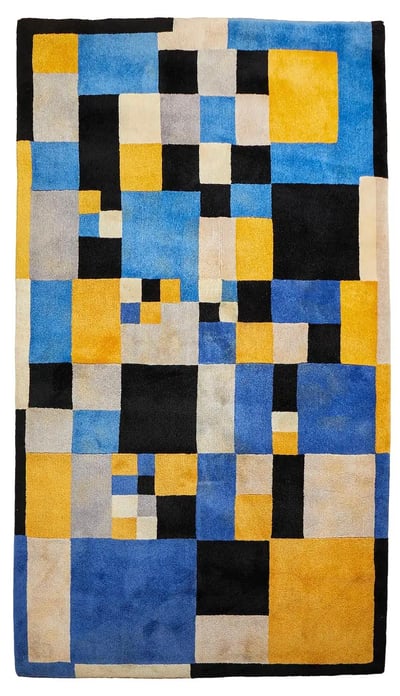
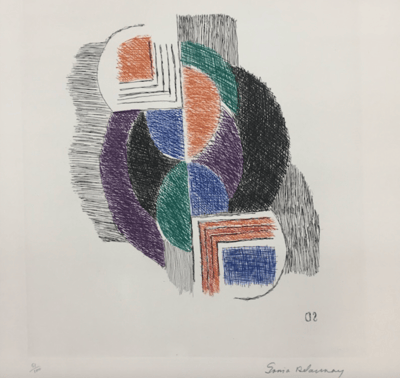
Carrés Magique by Sonia Delaunay, created around 1980, is a vibrant tapestry that reflects the artist’s signature exploration of color, rhythm, and geometry. This wool carpet, produced by Artcurial editions, is a stunning representation of Delaunay’s abstract style, where squares and rectangles in shades of blue, yellow, black, and cream interlock to create a dynamic, almost musical composition. The repetitive geometry of the squares evokes a sense of movement and energy, a hallmark of Delaunay’s work, which often sought to bring art into everyday objects. The bold color contrasts, along with the soft texture of the wool, make this tapestry both visually striking and tactilely inviting. This piece captures Delaunay’s vision of integrating art and design, blending fine art with functionality in a timeless modernist approach.
Sonia Delaunay (Ukraine/France, 1885–1979) was a pioneering artist and designer, celebrated for her vibrant abstract works and use of color. A key figure in the Orphism movement, she applied her innovative style to painting, textiles, and fashion. Delaunay’s legacy bridges fine art and design, influencing modern aesthetics profoundly.
Tapestry Tapestry is a heavy, handwoven textile featuring intricate designs or images woven directly into the fabric. Created by skilled weavers using materials like wool, linen, cotton, silk, and sometimes silver and gold threads, tapestries have historically served as art pieces, decorations, insulation, and symbols of authority.
Carrés Magique by Sonia Delaunay, created around 1980, is a vibrant tapestry that reflects the artist’s signature exploration of color, rhythm, and geometry. This wool carpet, produced by Artcurial editions, is a stunning representation of Delaunay’s abstract style, where squares and rectangles in shades of blue, yellow, black, and cream interlock to create a dynamic, almost musical composition. The repetitive geometry of the squares evokes a sense of movement and energy, a hallmark of Delaunay’s work, which often sought to bring art into everyday objects. The bold color contrasts, along with the soft texture of the wool, make this tapestry both visually striking and tactilely inviting. This piece captures Delaunay’s vision of integrating art and design, blending fine art with functionality in a timeless modernist approach.
Sonia Delaunay (Ukraine/France, 1885–1979) was a pioneering artist and designer, celebrated for her vibrant abstract works and use of color. A key figure in the Orphism movement, she applied her innovative style to painting, textiles, and fashion. Delaunay’s legacy bridges fine art and design, influencing modern aesthetics profoundly.
Sonia Delaunay was a French artist who helped found France's Orphism art movement. This particular style makes use of geometric figures and bold colors. She was a painter who also delved into textile and stage set design, and was known for employing geometric abstraction in her work. This is exemplified in "Rythme", an oil painting created by Delaunay in 1938 that features circles and curves of vibrant color. Delaunay often collaborated with her husband, artist Robert Delaunay, and they shared a similar style of painting. They both worked on decorating the pavilions at the Exposition Internationale des Arts et Techniques dans la Vie Moderne in 1937. In addition to her paintings, Delaunay designed a range of fabrics, wall coverings, furniture, and clothing. Much like her paintings, Sonia's textiles and modern design pieces featured geometric abstraction. In 1964, Sonia Delaunay became the first woman to have her work shown at a retrospective exhibition at the Louvre while still living. She received the privilege of being named an officer of France's Legion of Honor in 1975.
Abstract art uses form, shape, line, and color to create a visual experience without attempting to represent external reality. The composition exists independently of the world's visual references, focusing on expressing ideas and emotions through non-representational means.