Some minor foxing near the edges. Fresh colors, paper in great condition.
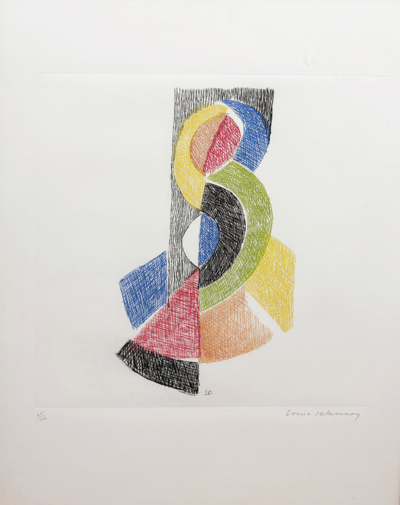
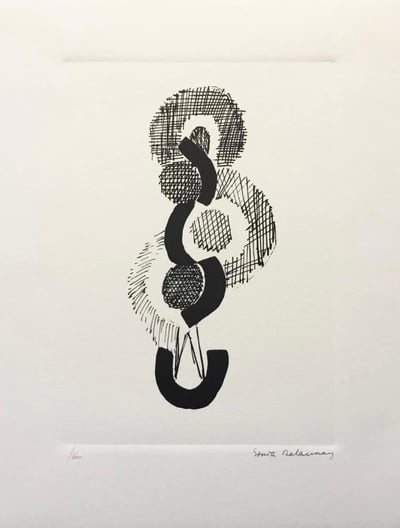
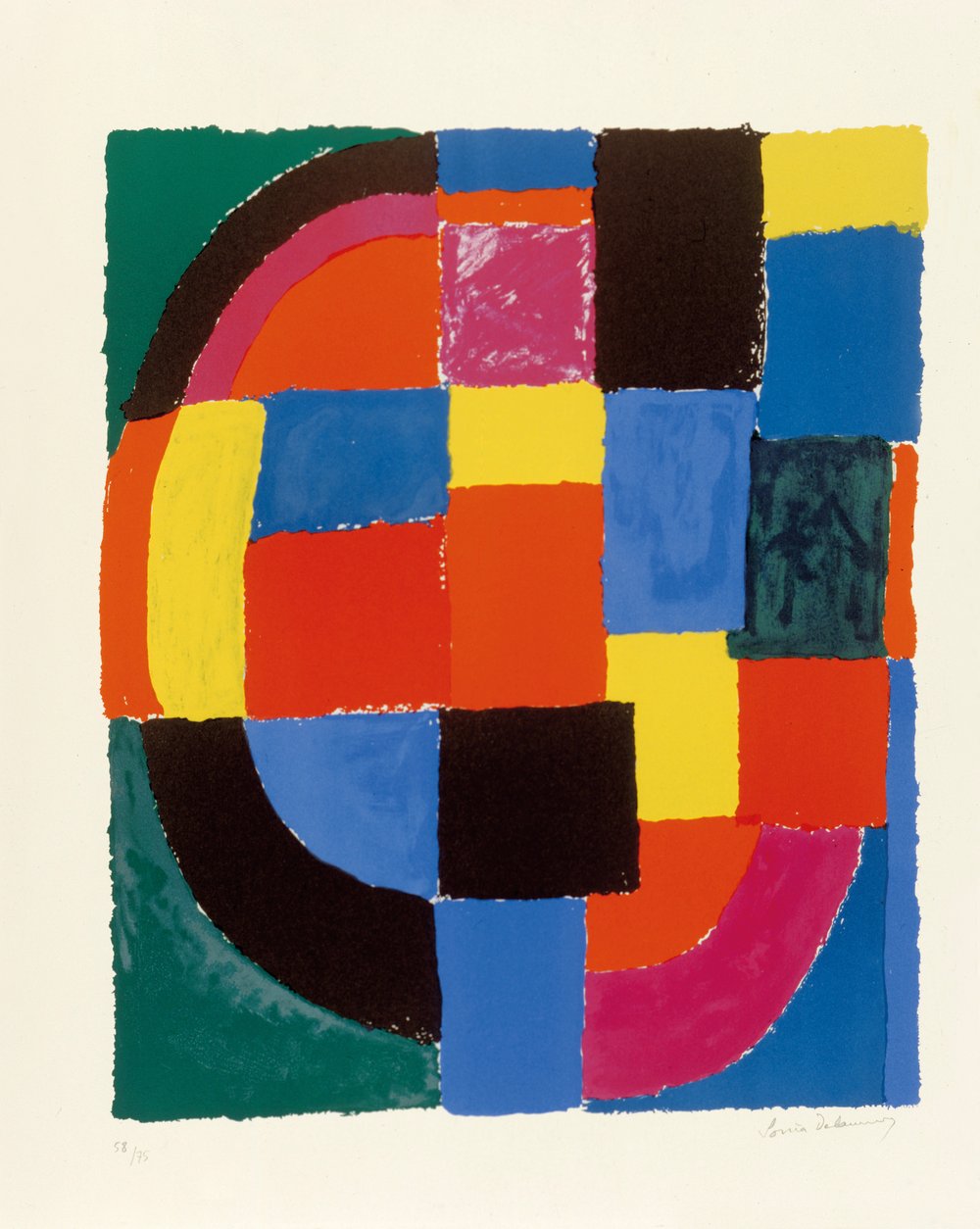
Le Guépard by Sonia Delaunay, created in 1970, is a vibrant silkscreen print that highlights her mastery in abstract art and color theory. The composition features a patchwork of geometric shapes, where bold colors such as blue, red, yellow, black, and green interact dynamically. The interplay of curved and rectangular forms creates a sense of movement and rhythm, characteristic of Delaunay’s exploration of Orphism. The arrangement of colors and shapes gives the work an energetic and harmonious feel, inviting viewers to engage with its visual intensity. Measuring 80 cm × 57 cm, this piece exemplifies Delaunay’s vision of color as a means of expression and emotion.
Sonia Delaunay (Ukraine/France, 1885–1979) was a pioneering artist and designer, celebrated for her vibrant abstract works and use of color. A key figure in the Orphism movement, she applied her innovative style to painting, textiles, and fashion. Delaunay’s legacy bridges fine art and design, influencing modern aesthetics profoundly.
Silkscreen Silkscreen is a printmaking method that uses a screen made of silk or other mesh fabric. The screen is treated with a substance that blocks ink in certain areas, allowing ink to pass through only in the desired sections. Each color in the print requires a separate screen.
Some minor foxing near the edges. Fresh colors, paper in great condition.
Le Guépard by Sonia Delaunay, created in 1970, is a vibrant silkscreen print that highlights her mastery in abstract art and color theory. The composition features a patchwork of geometric shapes, where bold colors such as blue, red, yellow, black, and green interact dynamically. The interplay of curved and rectangular forms creates a sense of movement and rhythm, characteristic of Delaunay’s exploration of Orphism. The arrangement of colors and shapes gives the work an energetic and harmonious feel, inviting viewers to engage with its visual intensity. Measuring 80 cm × 57 cm, this piece exemplifies Delaunay’s vision of color as a means of expression and emotion.
Sonia Delaunay (Ukraine/France, 1885–1979) was a pioneering artist and designer, celebrated for her vibrant abstract works and use of color. A key figure in the Orphism movement, she applied her innovative style to painting, textiles, and fashion. Delaunay’s legacy bridges fine art and design, influencing modern aesthetics profoundly.
Sonia Delaunay was a French artist who helped found France's Orphism art movement. This particular style makes use of geometric figures and bold colors. She was a painter who also delved into textile and stage set design, and was known for employing geometric abstraction in her work. This is exemplified in "Rythme", an oil painting created by Delaunay in 1938 that features circles and curves of vibrant color. Delaunay often collaborated with her husband, artist Robert Delaunay, and they shared a similar style of painting. They both worked on decorating the pavilions at the Exposition Internationale des Arts et Techniques dans la Vie Moderne in 1937. In addition to her paintings, Delaunay designed a range of fabrics, wall coverings, furniture, and clothing. Much like her paintings, Sonia's textiles and modern design pieces featured geometric abstraction. In 1964, Sonia Delaunay became the first woman to have her work shown at a retrospective exhibition at the Louvre while still living. She received the privilege of being named an officer of France's Legion of Honor in 1975.
Geometric abstraction is a form of abstract art that uses geometric shapes arranged in a non-illusionistic space (though not always) and combined into non-representational (non-objective) compositions. Based on years of artistic research, some artists have proposed that geometric abstraction offers a solution to modern challenges by rejecting traditional illusionistic practices in favor of clarity and simplicity.