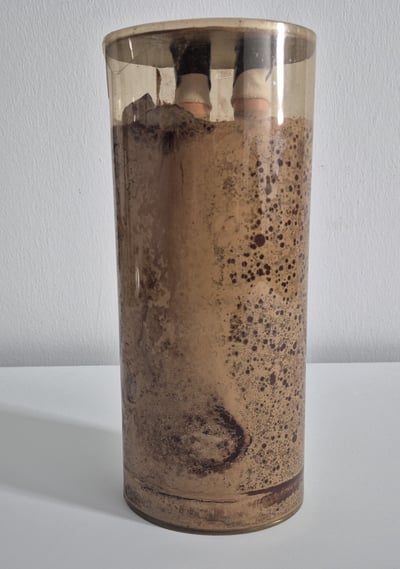
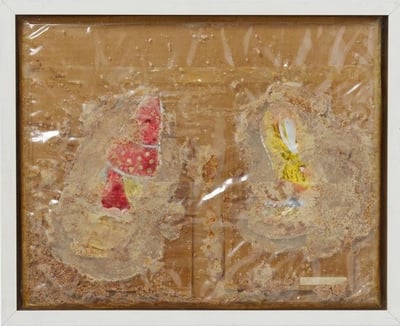
Chocolate Easter bunny and chocolate Father Christmas, tin foil and cardboard collage on paper, held in plastic in frame - Hand signed and numbered
Lauf der Welt by Dieter Roth is a mixed media piece from 1970, blending unconventional materials to explore themes of impermanence and decay. The work features a chocolate Easter bunny and a chocolate Father Christmas, along with tin foil and cardboard, all assembled into a collage on paper. The composition is encased in plastic, which not only preserves but also accentuates the decomposing and fragile nature of the materials. Roth, known for his experimental approach and his interest in the ephemeral, uses these edible and perishable objects to comment on the transient nature of life and art. The piece, hand-signed and numbered, encapsulates Roth's fascination with entropy and the passage of time.
Dieter Roth (Switzerland, 1930–1998) was a multifaceted artist known for his innovative use of materials, including decaying food, in sculptures and installations. His work often explored themes of transformation and impermanence, challenging traditional art boundaries. Roth's contributions significantly influenced contemporary art practices.
Mixed MediaMixed media refers to artwork that incorporates more than one medium within a single piece. Unlike multimedia art, which combines distinct forms of visual art and often includes elements like sound, video, or digital media, mixed media focuses on combining traditional art materials, such as paint, ink, and collage. Mixed media art allows artists to achieve a wide range of effects and textures by layering and blending different materials.
Chocolate Easter bunny and chocolate Father Christmas, tin foil and cardboard collage on paper, held in plastic in frame - Hand signed and numbered
Lauf der Welt by Dieter Roth is a mixed media piece from 1970, blending unconventional materials to explore themes of impermanence and decay. The work features a chocolate Easter bunny and a chocolate Father Christmas, along with tin foil and cardboard, all assembled into a collage on paper. The composition is encased in plastic, which not only preserves but also accentuates the decomposing and fragile nature of the materials. Roth, known for his experimental approach and his interest in the ephemeral, uses these edible and perishable objects to comment on the transient nature of life and art. The piece, hand-signed and numbered, encapsulates Roth's fascination with entropy and the passage of time.
Dieter Roth (Switzerland, 1930–1998) was a multifaceted artist known for his innovative use of materials, including decaying food, in sculptures and installations. His work often explored themes of transformation and impermanence, challenging traditional art boundaries. Roth's contributions significantly influenced contemporary art practices.
An eyewitness account is evidence that an artist has proposed a work of art.
- Dieter Roth
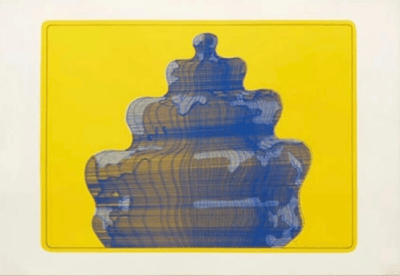
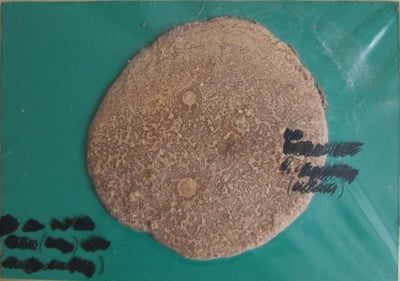
Dieter Roth, also known as Dieter Rot and Diter Rot, was a German-born Icelandic artist most known for his artist’s books, sculptures, and installations, although he worked in drawing and painting as well. He worked with the Concrete, Fluxus, Op, and Maximalism art movements, though he was not fully committed to any specific movement. Much of Dieter Roth's early career was spent in Iceland, which was isolated from most of the European modernist movements, so Dieter Roth had the opportunity to develop a unique aesthetic. Dieter Roth’s work used a wide variety of unconventional mediums, including found material, biodegradable material, and food. Sculpture material included chocolate, banana, cheese, and rabbit excrement. Dieter Roth’s major contribution was creating the modern artist’s book. A key work is Literaturwurst (Literature Sausage, 1961 – 1964), which was made by processing and binding published text as sausage, and affixing the cover of the book to the sausage wrapper. These sausage books were the forerunner to later pieces that used food as the medium, often rotting food. The most well-known was the Staple Cheese (A Chase) exhibition, a series featuring suitcases filled with cheese along with cheese mounted on the gallery walls. The cheese would rot and degrade over time. Dieter Roth focused on large installations in the 1980s and 90s. His most famous work of this period was Gartenskulptor (Garden Sculpture), which was a constantly evolving installation featuring various diverse art pieces mounted on trellises. The installation was assembled and re-assembled in various gardens, and later indoors.
The Uncanny is a concept described by psychologist Sigmund Freud as the eerie or unsettling feeling that arises when something familiar is presented in a strange or unfamiliar way. Surrealist artists, who aimed to reveal the subconscious and merge it with reality, often utilized this concept by combining familiar objects in unexpected and bizarre ways. This approach created a sense of discomfort or unease, challenging the viewer's perception of reality.