Signed and dated.
Print in five colors on smooth cardboard.
One of 100 copies for the Hamburg Art Association. (every version is unique).
D. Dobke, Dieter Roth - Druckgraphik, Catalogue Raisonné 1946-1998, Hamburg/London 2003, no. 240.
Published by the Hamburger Kunstverein, Hamburg
Image: 48 x 68cm.
Sheet: 50 x 70 cm.
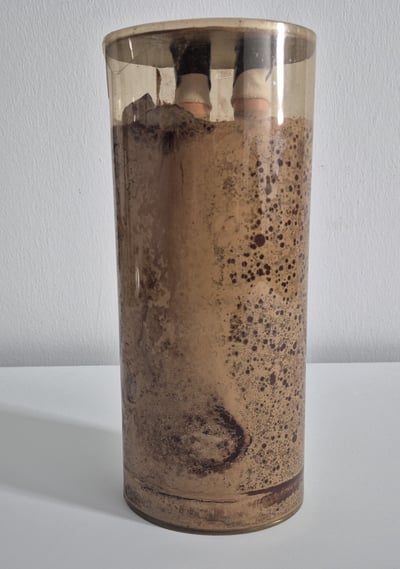
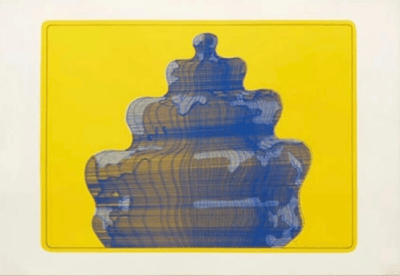
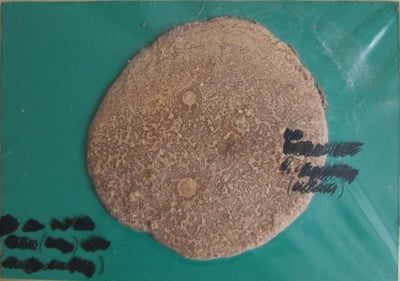
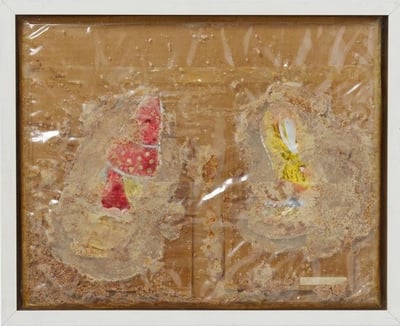
Dieter Roth’s Selbstbildnis als Loch (1972) is a screenprint in five colors, created as part of a unique series of 100 prints for the Hamburger Kunstverein. Each version is distinct, emphasizing Roth’s experimental and process-driven approach to printmaking. The composition features a silhouetted self-portrait, interrupted by a vibrant grid of overlapping colors and geometric patterns. The "hole" in the image suggests themes of absence, self-erasure, and transformation, concepts central to Roth’s work. By distorting the traditional self-portrait, he challenges the viewer’s perception of identity and representation. This piece, documented in Dieter Roth – Druckgraphik, Catalogue Raisonné, highlights his innovative contributions to contemporary printmaking.
Dieter Roth (Switzerland, 1930–1998) was a multifaceted artist known for his innovative use of materials, including decaying food, in sculptures and installations. His work often explored themes of transformation and impermanence, challenging traditional art boundaries. Roth's contributions significantly influenced contemporary art practices.
Screen-print Screen printing is a technique where ink is transferred through a mesh onto a substrate, with areas blocked by a stencil to prevent ink from passing through. This method, also known as serigraphy or silkscreen printing, is commonly used to produce prints on posters, T-shirts, vinyl, stickers, wood, and other materials. The process is a type of stencil printing, allowing for vibrant, detailed designs on various surfaces.
Signed and dated.
Print in five colors on smooth cardboard.
One of 100 copies for the Hamburg Art Association. (every version is unique).
D. Dobke, Dieter Roth - Druckgraphik, Catalogue Raisonné 1946-1998, Hamburg/London 2003, no. 240.
Published by the Hamburger Kunstverein, Hamburg
Image: 48 x 68cm.
Sheet: 50 x 70 cm.
Dieter Roth’s Selbstbildnis als Loch (1972) is a screenprint in five colors, created as part of a unique series of 100 prints for the Hamburger Kunstverein. Each version is distinct, emphasizing Roth’s experimental and process-driven approach to printmaking. The composition features a silhouetted self-portrait, interrupted by a vibrant grid of overlapping colors and geometric patterns. The "hole" in the image suggests themes of absence, self-erasure, and transformation, concepts central to Roth’s work. By distorting the traditional self-portrait, he challenges the viewer’s perception of identity and representation. This piece, documented in Dieter Roth – Druckgraphik, Catalogue Raisonné, highlights his innovative contributions to contemporary printmaking.
Dieter Roth (Switzerland, 1930–1998) was a multifaceted artist known for his innovative use of materials, including decaying food, in sculptures and installations. His work often explored themes of transformation and impermanence, challenging traditional art boundaries. Roth's contributions significantly influenced contemporary art practices.
An eyewitness account is evidence that an artist has proposed a work of art.
- Dieter Roth
Dieter Roth, also known as Dieter Rot and Diter Rot, was a German-born Icelandic artist most known for his artist’s books, sculptures, and installations, although he worked in drawing and painting as well. He worked with the Concrete, Fluxus, Op, and Maximalism art movements, though he was not fully committed to any specific movement. Much of Dieter Roth's early career was spent in Iceland, which was isolated from most of the European modernist movements, so Dieter Roth had the opportunity to develop a unique aesthetic. Dieter Roth’s work used a wide variety of unconventional mediums, including found material, biodegradable material, and food. Sculpture material included chocolate, banana, cheese, and rabbit excrement. Dieter Roth’s major contribution was creating the modern artist’s book. A key work is Literaturwurst (Literature Sausage, 1961 – 1964), which was made by processing and binding published text as sausage, and affixing the cover of the book to the sausage wrapper. These sausage books were the forerunner to later pieces that used food as the medium, often rotting food. The most well-known was the Staple Cheese (A Chase) exhibition, a series featuring suitcases filled with cheese along with cheese mounted on the gallery walls. The cheese would rot and degrade over time. Dieter Roth focused on large installations in the 1980s and 90s. His most famous work of this period was Gartenskulptor (Garden Sculpture), which was a constantly evolving installation featuring various diverse art pieces mounted on trellises. The installation was assembled and re-assembled in various gardens, and later indoors.
The Uncanny is a concept described by psychologist Sigmund Freud as the eerie or unsettling feeling that arises when something familiar is presented in a strange or unfamiliar way. Surrealist artists, who aimed to reveal the subconscious and merge it with reality, often utilized this concept by combining familiar objects in unexpected and bizarre ways. This approach created a sense of discomfort or unease, challenging the viewer's perception of reality.