

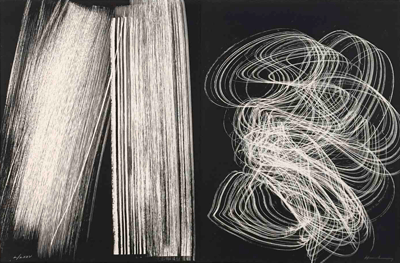
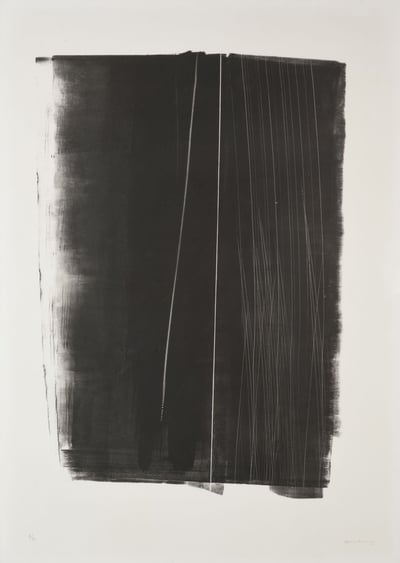
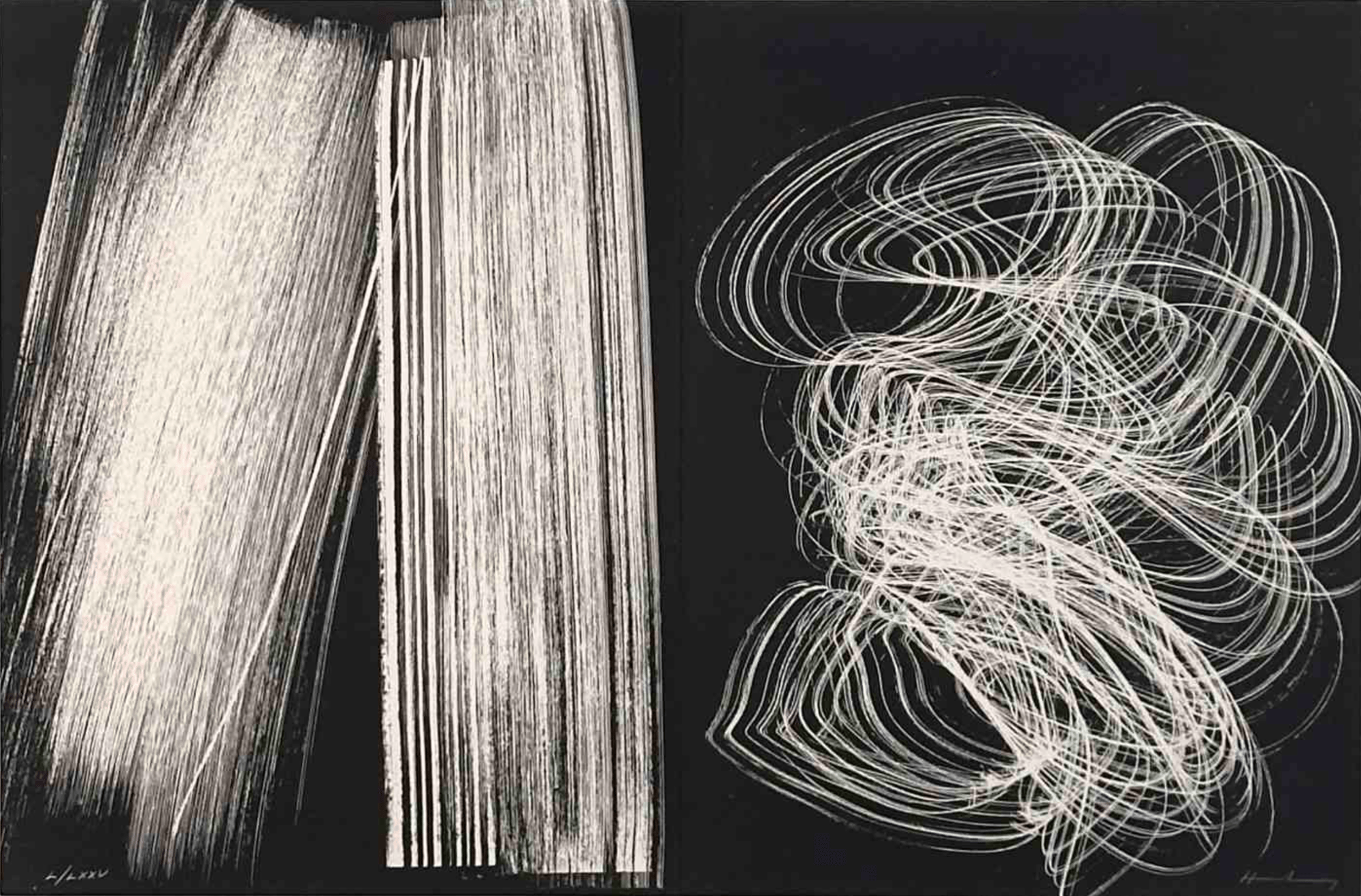
Lithograph, center fold. Hand-signed and numbered. // Farandole V divides into two movements across a deep black ground. On the left, a dense sheaf of fine white striations falls like brushed light or rain, taut and vertical; on the right, looping white lines tangle into a restless, swirling knot of pure energy. The contrast between disciplined descent and free coiling gesture captures the essence of Hartung's lyrical abstraction. A pioneer of European gestural mark-making, he hand-signed and numbered this 1970 lithograph, complete with its characteristic centre fold, an exhilarating record of the hand in motion.
Farandole V, L-1970-5, 1970
Form
Medium
Size
- Inches
- Centimeters
Edition
Price
- USD
- EUR
- GBP
- CHF
- Authenticity Guaranteed
- Insured Shipping
- Online Since 2005
Lithograph, center fold. Hand-signed and numbered. // Farandole V divides into two movements across a deep black ground. On the left, a dense sheaf of fine white striations falls like brushed light or rain, taut and vertical; on the right, looping white lines tangle into a restless, swirling knot of pure energy. The contrast between disciplined descent and free coiling gesture captures the essence of Hartung's lyrical abstraction. A pioneer of European gestural mark-making, he hand-signed and numbered this 1970 lithograph, complete with its characteristic centre fold, an exhilarating record of the hand in motion.
Hans Hartung
Lithograph X from Farandole, 1971
Limited Edition Print
Lithograph
USD 1,280
Hans Hartung
Farandole V, L-1970-5, 1970
Limited Edition Print
Lithograph
EUR 1,700
Hans Hartung
KP1972-3, 1972
Painting
Acrylic on paper
Inquire For Price
Hans Hartung
G 1970-21, 1970
Limited Edition Print
Etching
EUR 6,500
Hans Hartung
L 1973-46, 1973
Limited Edition Print
Lithograph
EUR 2,050

Hans Hartung
G 1973-2, 1973
Limited Edition Print
Etching
EUR 2,250
Hans Hartung
Lithograph V from Farandole, 1971
Limited Edition Print
Lithograph
USD 1,280

Hans Hartung
Lithograph XII from Farandole, 1971
Limited Edition Print
Lithograph
USD 1,280
Hans Hartung
Las Estampas de la Cometa 5, 1971
Limited Edition Print
Etching
EUR 1,550
Hans Hartung
Las Estampas de la Cometa 4, 1971
Limited Edition Print
Etching
EUR 1,550
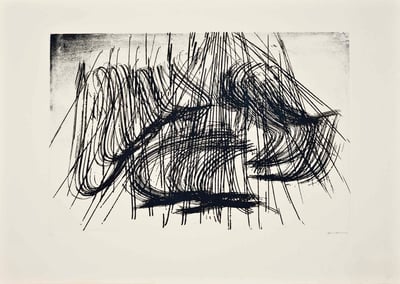
Hans Hartung
Las Estampas de la Cometa 1, 1971
Limited Edition Print
Etching
EUR 1,550
Related Artists


What is Tachisme?
Tachisme is a French abstract painting style that gained popularity between 1940 and 1950, often seen as the European counterpart to Abstract Expressionism. However, there are stylistic differences between the two. Tachisme, which emerged from Art Informel, rejected geometric abstraction in favor of more intuitive and spontaneous expression. It was a reaction against the structured forms of Cubism and is closely related to Informalism. Tachisme emphasizes gestural brushwork, irregular forms, and a focus on the process of painting itself.
Hans Hartung
Farandole V, L-1970-5, 1970
49 x 74.2 cm


