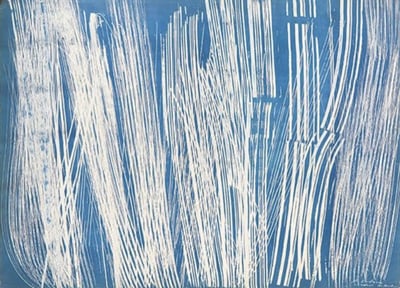
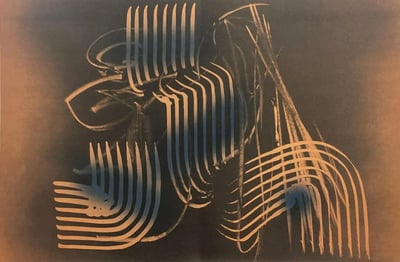
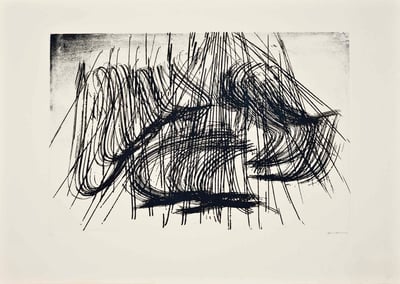
Etching on Arches paper, embossed white lines on a blue background.
Hand-signed and dedicated to Joan Barbarà.
Published by Gustavo Gili, Barcelona.
Bibliography: Rainer Michael Mason: "Hans Hartung. Les Estampes – Catalogue raisonné."
Fondation Hans Hartung et Anna-Eva Bergman, Antibes, 2010. Cat. no. RMM 303.
Luminous white lines score deep furrows across an expansive field of saturated blue, their embossed ridges catching light and casting subtle shadows that shift with the viewer's position. Hartung's G 1970-21 exemplifies the artist's pioneering approach to etching as a medium of physical presence, where the plate becomes a field of sculptural energy rather than mere image. The bold interplay of incised gesture against chromatic depth recalls the cosmic sweep of Hartung's large canvases, condensed here into the intimate format of the print. Published by Gustavo Gili and bearing a personal dedication to the master printer Joan Barbarà, this is a rare and historically significant impression.
Hans Hartung (Germany/France, 1904–1989) was a German-French painter renowned for his gestural abstract style. A leading figure in Art Informel and Lyrical Abstraction, he utilized dynamic brushstrokes and innovative techniques to convey emotion and spontaneity. Hartung's work significantly influenced post-war European abstraction.
EtchingEtching is a technique where a design is created on a metal surface by using a strong acid or mordant to eat away the unprotected parts of the metal, leaving the desired pattern in relief (intaglio). In modern art and manufacturing, different chemicals may be used depending on the material being etched.
Etching on Arches paper, embossed white lines on a blue background.
Hand-signed and dedicated to Joan Barbarà.
Published by Gustavo Gili, Barcelona.
Bibliography: Rainer Michael Mason: "Hans Hartung. Les Estampes – Catalogue raisonné."
Fondation Hans Hartung et Anna-Eva Bergman, Antibes, 2010. Cat. no. RMM 303.
Luminous white lines score deep furrows across an expansive field of saturated blue, their embossed ridges catching light and casting subtle shadows that shift with the viewer's position. Hartung's G 1970-21 exemplifies the artist's pioneering approach to etching as a medium of physical presence, where the plate becomes a field of sculptural energy rather than mere image. The bold interplay of incised gesture against chromatic depth recalls the cosmic sweep of Hartung's large canvases, condensed here into the intimate format of the print. Published by Gustavo Gili and bearing a personal dedication to the master printer Joan Barbarà, this is a rare and historically significant impression.
Hans Hartung (Germany/France, 1904–1989) was a German-French painter renowned for his gestural abstract style. A leading figure in Art Informel and Lyrical Abstraction, he utilized dynamic brushstrokes and innovative techniques to convey emotion and spontaneity. Hartung's work significantly influenced post-war European abstraction.
Everything we feel deeply must be expressed.
- Hans Hartung
Hans Hartung was a German-French painter best known for gesturalabstract art. He developed his appreciation for German painters early in his life and enrolled in the Fine Arts academy of Dresden where he replicated paintings of the masters. Hans Hartung left his native country and moved to Paris where he had little contact with other artists and replicated the works of old and modern masters. After many trials through his personal life, Hans Hartung had his first solo exhibit in 1947 and by the late 1950’s his gestural paintings used almost all monochromatic. His uses of long rhythmical brushstrokes or scratches were characterizations of Hans's art work. He explored and experimented with different tools including; plant fronds, lithography, gardening tools and the wheels of a wheelchair. He received the International Grand Prix award at the Venice Biennale. Hans's technique of freewheeling abstract paintings set a precedent for painters to come. Young American painters in the 60's saw him as an important forerunner of American Lyrical Abstraction. Warren Forma featured him in the 1963 film documentary, "School of Paris." In his last year, Hans's focus was on presenting a sense of freedom and ambition that connected to his earlier work. The pieces hint at a natural world with qualities of shadow and light. They remain witness to his continuous and fearless exploration.
Gestural art is a term that describes painting with freely sweeping brushstrokes. The primary goal of gestural art is to allow the artist to physically express emotional impulses. The varied, yet expressive paint marks are intended to convey the artist's inner thoughts and emotions, which viewers are believed to understand through the dynamic and spontaneous application of paint.