Original Lithograph in Colors on Paper - Suite: Farandole
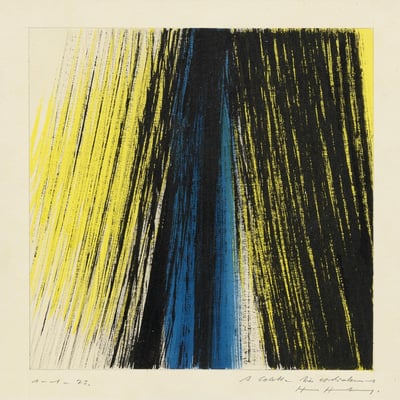
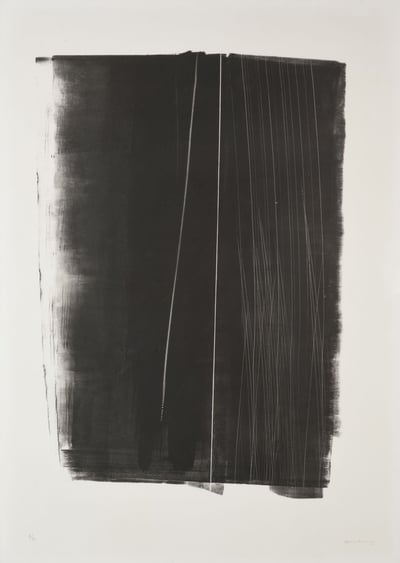
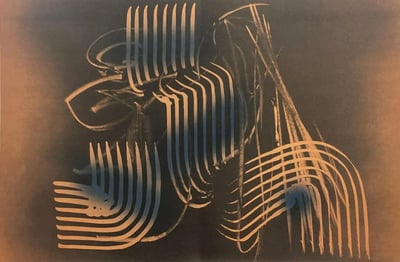
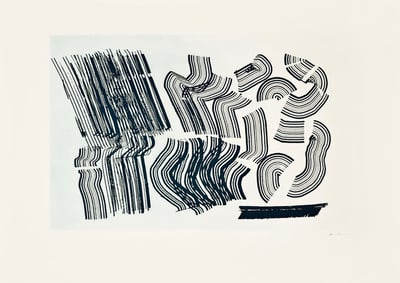
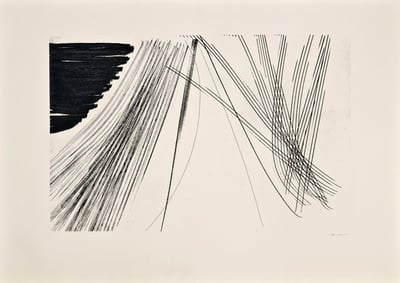
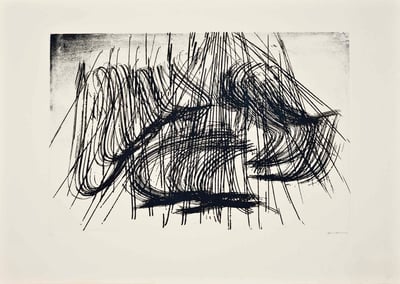
Hans Hartung's Lithograph III from Farandole (1971) is a bold abstract work characterized by sweeping black brushstrokes against a muted yellow backdrop. The dynamic and expressive motion of the strokes conveys a sense of energy and spontaneity, highlighting Hartung’s expertise in gestural abstraction. The contrast between the dark form and the light background creates a striking visual impact, emphasizing the fluidity and force of the gesture. Part of the Farandole suite, this piece encapsulates the essence of Hartung’s approach to exploring movement and emotion through minimalistic, yet powerful compositions.
Hans Hartung (Germany/France, 1904–1989) was a German-French painter renowned for his gestural abstract style. A leading figure in Art Informel and Lyrical Abstraction, he utilized dynamic brushstrokes and innovative techniques to convey emotion and spontaneity. Hartung's work significantly influenced post-war European abstraction.
Lithograph Lithography is a printing method based on the principle that water and oil do not mix. It can be used to print artwork or text onto paper or other suitable materials. Traditionally, an image was drawn with wax, fat, or oil onto a lithographic limestone surface or plate. Today, metal plates and other surfaces are also used in lithographic printing.
Original Lithograph in Colors on Paper - Suite: Farandole
Hans Hartung's Lithograph III from Farandole (1971) is a bold abstract work characterized by sweeping black brushstrokes against a muted yellow backdrop. The dynamic and expressive motion of the strokes conveys a sense of energy and spontaneity, highlighting Hartung’s expertise in gestural abstraction. The contrast between the dark form and the light background creates a striking visual impact, emphasizing the fluidity and force of the gesture. Part of the Farandole suite, this piece encapsulates the essence of Hartung’s approach to exploring movement and emotion through minimalistic, yet powerful compositions.
Hans Hartung (Germany/France, 1904–1989) was a German-French painter renowned for his gestural abstract style. A leading figure in Art Informel and Lyrical Abstraction, he utilized dynamic brushstrokes and innovative techniques to convey emotion and spontaneity. Hartung's work significantly influenced post-war European abstraction.
Everything we feel deeply must be expressed.
- Hans Hartung
Hans Hartung was a German-French painter best known for gesturalabstract art. He developed his appreciation for German painters early in his life and enrolled in the Fine Arts academy of Dresden where he replicated paintings of the masters. Hans Hartung left his native country and moved to Paris where he had little contact with other artists and replicated the works of old and modern masters. After many trials through his personal life, Hans Hartung had his first solo exhibit in 1947 and by the late 1950’s his gestural paintings used almost all monochromatic. His uses of long rhythmical brushstrokes or scratches were characterizations of Hans's art work. He explored and experimented with different tools including; plant fronds, lithography, gardening tools and the wheels of a wheelchair. He received the International Grand Prix award at the Venice Biennale. Hans's technique of freewheeling abstract paintings set a precedent for painters to come. Young American painters in the 60's saw him as an important forerunner of American Lyrical Abstraction. Warren Forma featured him in the 1963 film documentary, "School of Paris." In his last year, Hans's focus was on presenting a sense of freedom and ambition that connected to his earlier work. The pieces hint at a natural world with qualities of shadow and light. They remain witness to his continuous and fearless exploration.
Abstract Expressionism is an art movement that emerged in the United States during the 1940s and 1950s. Characterized by large, abstract canvases, the movement emphasized spontaneous, expressive brushwork and the use of color and form to convey emotion rather than represent reality. Artists like Jackson Pollock, Mark Rothko, and Willem de Kooning are key figures in this movement. Abstract Expressionism marked a shift in the art world, making New York City a center of the international art scene.