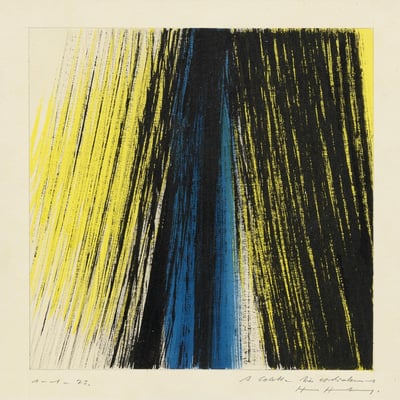
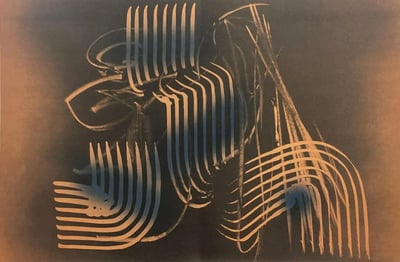
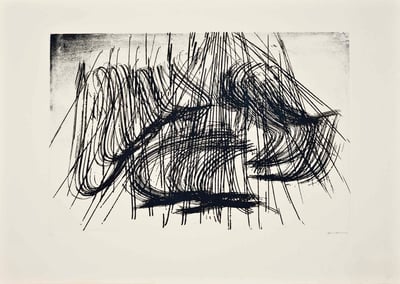
Signed, dated "1-1-73" and dedicated "A Colette très cordialement Hans Hartung", and on the reverse titled "KP1972-3" and dated "le 9. 3. 72" and inscribed "PHOT. J 73 D" and "30 x 30.2 cm". The work is included in the forthcoming catalogue raisonné of the Hans Hartung and Anna-Eva Bergman Foundation, Antibes, and is registered in the foundation's archive.
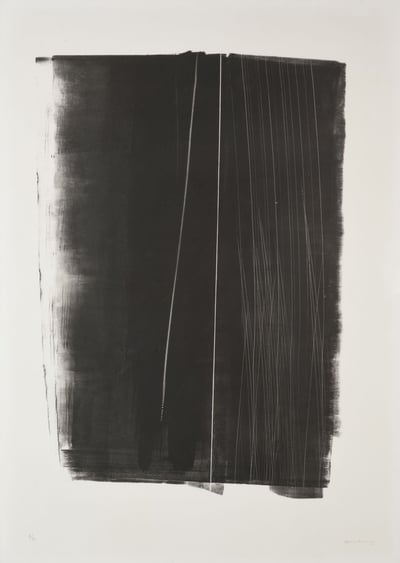
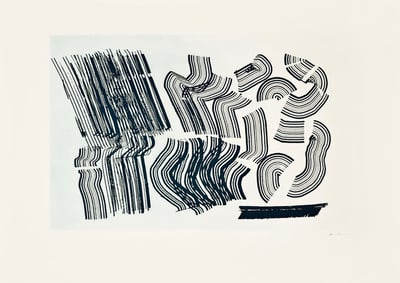
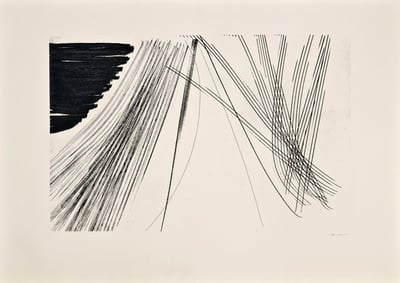
Hans Hartung's "KP1972-3" presents bold vertical gestural strokes in yellow, black, and blue acrylic on paper, demonstrating the artist's mastery of spontaneous mark-making within a controlled compositional framework. The sweeping lines converge from the upper portion of the square format, creating a dynamic interplay of chromatic energy and spatial depth. Dedicated to Colette and signed by the artist, this work reflects Hartung's position as a pioneer of gestural abstraction in Europe, predating American Abstract Expressionism with his commitment to the expressive autonomy of the painted line.
Hans Hartung (Germany/France, 1904–1989) was a German-French painter renowned for his gestural abstract style. A leading figure in Art Informel and Lyrical Abstraction, he utilized dynamic brushstrokes and innovative techniques to convey emotion and spontaneity. Hartung's work significantly influenced post-war European abstraction.
Acrylic on paperAcrylic on paper is a technique that involves using acrylic paints on various paper types and textures. Artists often choose watercolor paper with smooth or rough surfaces to apply acrylics using watercolor techniques such as bleeding, washing, and spattering. This approach allows for a wide range of effects, combining the flexibility of acrylics with the delicate qualities of watercolor methods.
Signed, dated "1-1-73" and dedicated "A Colette très cordialement Hans Hartung", and on the reverse titled "KP1972-3" and dated "le 9. 3. 72" and inscribed "PHOT. J 73 D" and "30 x 30.2 cm". The work is included in the forthcoming catalogue raisonné of the Hans Hartung and Anna-Eva Bergman Foundation, Antibes, and is registered in the foundation's archive.
Hans Hartung's "KP1972-3" presents bold vertical gestural strokes in yellow, black, and blue acrylic on paper, demonstrating the artist's mastery of spontaneous mark-making within a controlled compositional framework. The sweeping lines converge from the upper portion of the square format, creating a dynamic interplay of chromatic energy and spatial depth. Dedicated to Colette and signed by the artist, this work reflects Hartung's position as a pioneer of gestural abstraction in Europe, predating American Abstract Expressionism with his commitment to the expressive autonomy of the painted line.
Hans Hartung (Germany/France, 1904–1989) was a German-French painter renowned for his gestural abstract style. A leading figure in Art Informel and Lyrical Abstraction, he utilized dynamic brushstrokes and innovative techniques to convey emotion and spontaneity. Hartung's work significantly influenced post-war European abstraction.
Everything we feel deeply must be expressed.
- Hans Hartung
Hans Hartung was a German-French painter best known for gesturalabstract art. He developed his appreciation for German painters early in his life and enrolled in the Fine Arts academy of Dresden where he replicated paintings of the masters. Hans Hartung left his native country and moved to Paris where he had little contact with other artists and replicated the works of old and modern masters. After many trials through his personal life, Hans Hartung had his first solo exhibit in 1947 and by the late 1950’s his gestural paintings used almost all monochromatic. His uses of long rhythmical brushstrokes or scratches were characterizations of Hans's art work. He explored and experimented with different tools including; plant fronds, lithography, gardening tools and the wheels of a wheelchair. He received the International Grand Prix award at the Venice Biennale. Hans's technique of freewheeling abstract paintings set a precedent for painters to come. Young American painters in the 60's saw him as an important forerunner of American Lyrical Abstraction. Warren Forma featured him in the 1963 film documentary, "School of Paris." In his last year, Hans's focus was on presenting a sense of freedom and ambition that connected to his earlier work. The pieces hint at a natural world with qualities of shadow and light. They remain witness to his continuous and fearless exploration.
Postmodernism is an art movement that emerged as a reaction against authority and traditional boundaries, seeking to blur the lines between art and everyday life. It aimed to bridge the gap between the cultural elite and the general public by embracing eclectic mixtures of earlier conventions and styles. Postmodernist art often challenges established norms and celebrates diversity, irony, and pastiche, making it a movement that reflects the complexities of contemporary culture.