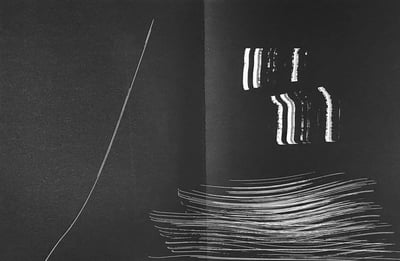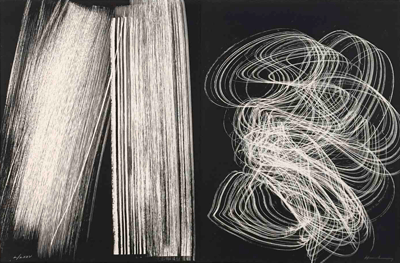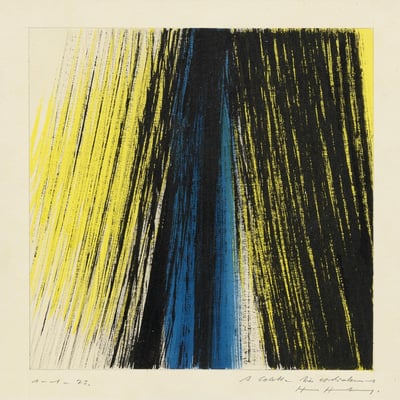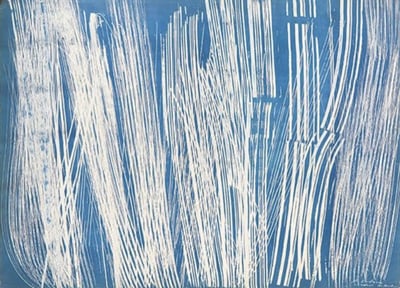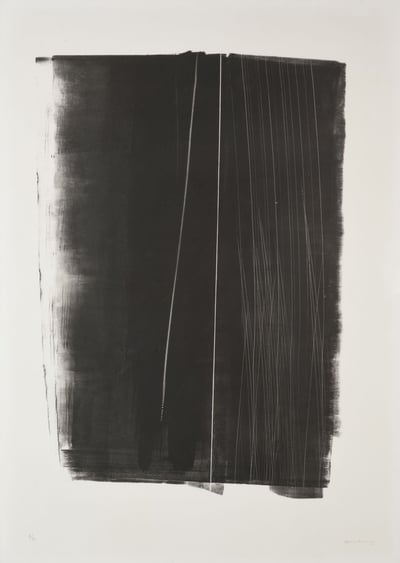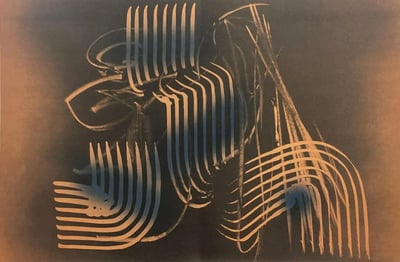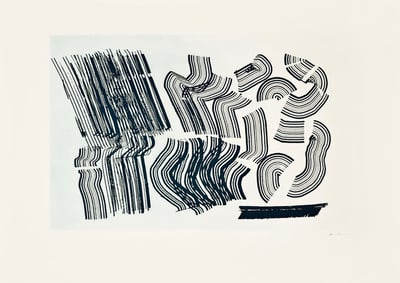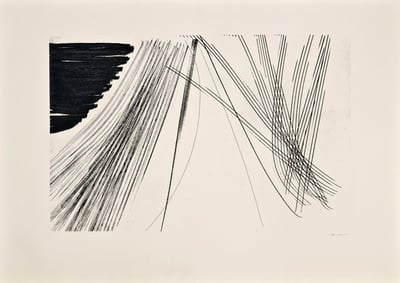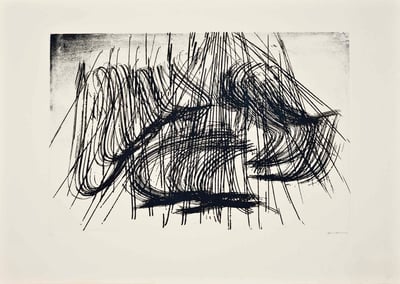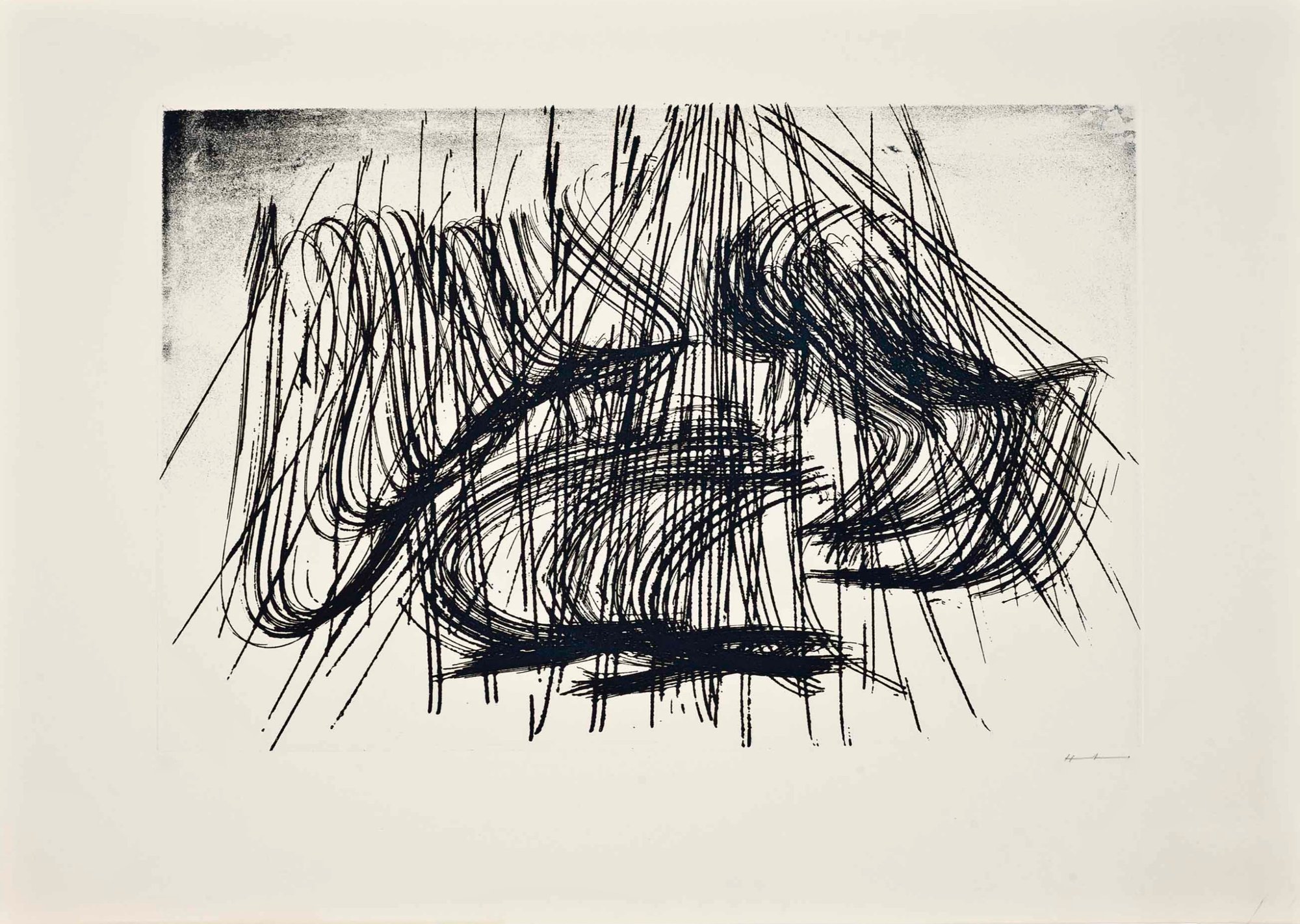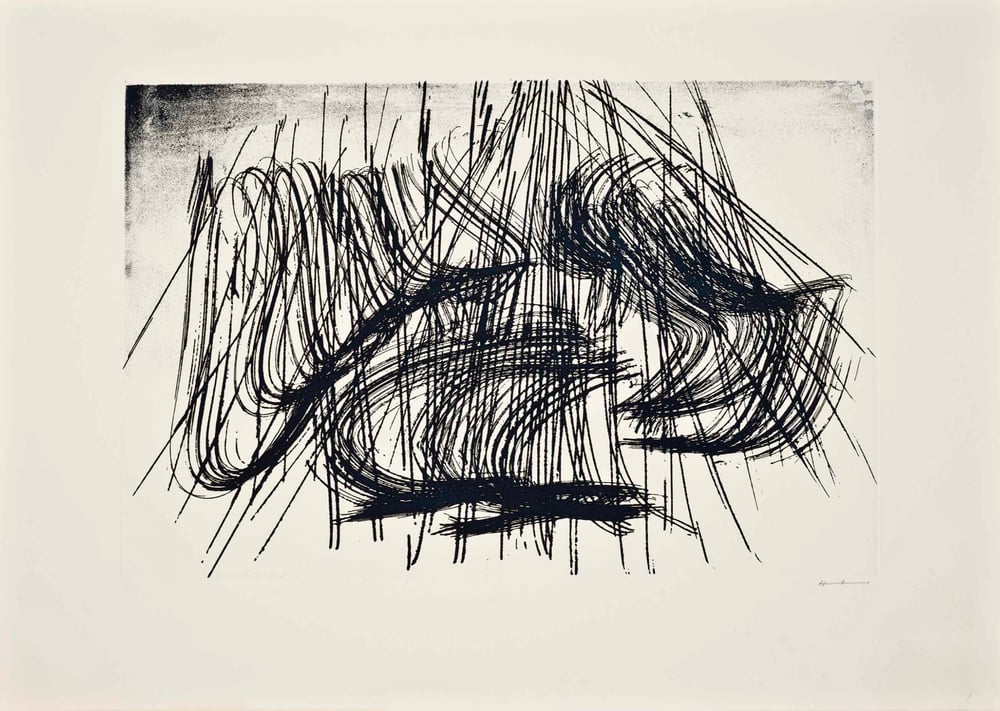
One of the 5 etchings, Las Estampas de la Cometa; Gustavo Gili, Barcelona, 1971 - On watermarked Arches paper - Plate: 52 x 79 cm. - Sheet: 75 x 105.3 cm.
Hans Hartung's Las Estampas de la Cometa 1 (1971) is an etching from a limited edition of 75 copies, plus HC (hors commerce), produced on watermarked Arches paper. Part of a series published by Gustavo Gili in Barcelona, this print exemplifies Hartung’s dynamic and gestural abstraction. Bold, sweeping black lines dominate the composition, creating a sense of movement and chaos against the stark white background. The energetic strokes and overlapping forms convey an intense emotional expression, typical of Hartung's post-war work. The artwork measures 52 x 79 cm on the plate and 75 x 105.3 cm overall, highlighting its expansive and immersive nature.
Hans Hartung (Germany/France, 1904–1989) was a German-French painter renowned for his gestural abstract style. A leading figure in Art Informel and Lyrical Abstraction, he utilized dynamic brushstrokes and innovative techniques to convey emotion and spontaneity. Hartung's work significantly influenced post-war European abstraction.
EtchingEtching is a technique where a design is created on a metal surface by using a strong acid or mordant to eat away the unprotected parts of the metal, leaving the desired pattern in relief (intaglio). In modern art and manufacturing, different chemicals may be used depending on the material being etched.
One of the 5 etchings, Las Estampas de la Cometa; Gustavo Gili, Barcelona, 1971 - On watermarked Arches paper - Plate: 52 x 79 cm. - Sheet: 75 x 105.3 cm.
Hans Hartung's Las Estampas de la Cometa 1 (1971) is an etching from a limited edition of 75 copies, plus HC (hors commerce), produced on watermarked Arches paper. Part of a series published by Gustavo Gili in Barcelona, this print exemplifies Hartung’s dynamic and gestural abstraction. Bold, sweeping black lines dominate the composition, creating a sense of movement and chaos against the stark white background. The energetic strokes and overlapping forms convey an intense emotional expression, typical of Hartung's post-war work. The artwork measures 52 x 79 cm on the plate and 75 x 105.3 cm overall, highlighting its expansive and immersive nature.
Hans Hartung (Germany/France, 1904–1989) was a German-French painter renowned for his gestural abstract style. A leading figure in Art Informel and Lyrical Abstraction, he utilized dynamic brushstrokes and innovative techniques to convey emotion and spontaneity. Hartung's work significantly influenced post-war European abstraction.
Everything we feel deeply must be expressed.
- Hans Hartung
Hans Hartung was a German-French painter best known for gesturalabstract art. He developed his appreciation for German painters early in his life and enrolled in the Fine Arts academy of Dresden where he replicated paintings of the masters. Hans Hartung left his native country and moved to Paris where he had little contact with other artists and replicated the works of old and modern masters. After many trials through his personal life, Hans Hartung had his first solo exhibit in 1947 and by the late 1950’s his gestural paintings used almost all monochromatic. His uses of long rhythmical brushstrokes or scratches were characterizations of Hans's art work. He explored and experimented with different tools including; plant fronds, lithography, gardening tools and the wheels of a wheelchair. He received the International Grand Prix award at the Venice Biennale. Hans's technique of freewheeling abstract paintings set a precedent for painters to come. Young American painters in the 60's saw him as an important forerunner of American Lyrical Abstraction. Warren Forma featured him in the 1963 film documentary, "School of Paris." In his last year, Hans's focus was on presenting a sense of freedom and ambition that connected to his earlier work. The pieces hint at a natural world with qualities of shadow and light. They remain witness to his continuous and fearless exploration.
Abstract Expressionism is an art movement that emerged in the United States during the 1940s and 1950s. Characterized by large, abstract canvases, the movement emphasized spontaneous, expressive brushwork and the use of color and form to convey emotion rather than represent reality. Artists like Jackson Pollock, Mark Rothko, and Willem de Kooning are key figures in this movement. Abstract Expressionism marked a shift in the art world, making New York City a center of the international art scene.