// Lästerzungen by Jörg Immendorff is a playful yet enigmatic screenprint featuring abstract figures set against a vibrant yellow background. The composition includes a prominent red form, centrally positioned and resembling a winged or organic shape, while smaller shapes in black, purple, and beige float around it. White tree-like silhouettes create a textured backdrop that adds depth and contrast to the piece. Immendorff’s work often engages with political and social themes, and while the exact symbolism of this piece is open to interpretation, the title Lästerzungen (translated as Malicious Tongues) suggests themes of gossip or critique. The whimsical forms and bright color palette lend the work a surreal, almost dreamlike quality, inviting viewers to explore the interplay between form, color, and potential meaning.
Jörg Immendorff (Germany, 1945–2007) was a German painter, sculptor, and stage designer associated with the Neue Wilde movement. His 'Café Deutschland' series critically examined German history and division. Immendorff's politically charged art often featured symbolic imagery, reflecting his engagement with social issues.
Screen-print Screen printing is a technique where ink is transferred through a mesh onto a substrate, with areas blocked by a stencil to prevent ink from passing through. This method, also known as serigraphy or silkscreen printing, is commonly used to produce prints on posters, T-shirts, vinyl, stickers, wood, and other materials. The process is a type of stencil printing, allowing for vibrant, detailed designs on various surfaces.
// Lästerzungen by Jörg Immendorff is a playful yet enigmatic screenprint featuring abstract figures set against a vibrant yellow background. The composition includes a prominent red form, centrally positioned and resembling a winged or organic shape, while smaller shapes in black, purple, and beige float around it. White tree-like silhouettes create a textured backdrop that adds depth and contrast to the piece. Immendorff’s work often engages with political and social themes, and while the exact symbolism of this piece is open to interpretation, the title Lästerzungen (translated as Malicious Tongues) suggests themes of gossip or critique. The whimsical forms and bright color palette lend the work a surreal, almost dreamlike quality, inviting viewers to explore the interplay between form, color, and potential meaning.
Jörg Immendorff (Germany, 1945–2007) was a German painter, sculptor, and stage designer associated with the Neue Wilde movement. His 'Café Deutschland' series critically examined German history and division. Immendorff's politically charged art often featured symbolic imagery, reflecting his engagement with social issues.
Whether or not the artist can fulfill a social function is a question that remains unanswered.
- Jorg Immendorf
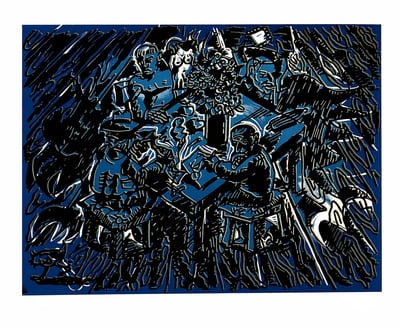
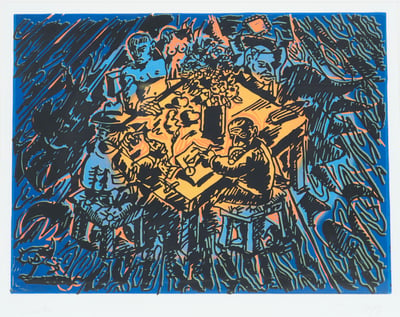
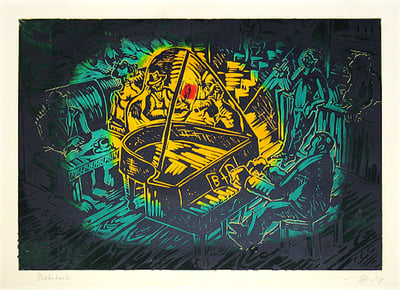
A member of the Neue Wilde movement, Jorg Immendorff received acclaim for his largely figurative work across the mediums of painting and sculpture – Jorg has explained the reason for his figurative style by simply stating: ‘something is beautiful if it is honest’. Among Immendorff’s earliest works was the LIDL group of performances, sculptures and paintings, all of which depicted iconographic motifs that one could expect to find among the make-believe world of a child - motifs included playhouses; goldfish, turtles and dogs, and the body of work was created as a derisive criticism of the present artistic pretensions. Immendorf was influenced by the works of Renato Guttuso, as evidenced in his Café Deutschland work - a series of sixteen large-scale, socio-political paintings that depicted disco-goers as a symbol of the division between East and West Germany. Immendorff was never afraid to challenge the social and political tensions of his time, and was on one occasion arrested for defaming the German flag after appearing outside West German Parliament with a wooden block tethered to his ankle – the block was labeled LIDL and painted in colours of the flag.
Lettrism is an art form that uses letters, words, and symbols to create artwork. The movement was established in Paris in the 1940s and later gained popularity in the 1950s in America. Lettrisme is the French spelling of the movement's name, derived from the French word for letter.