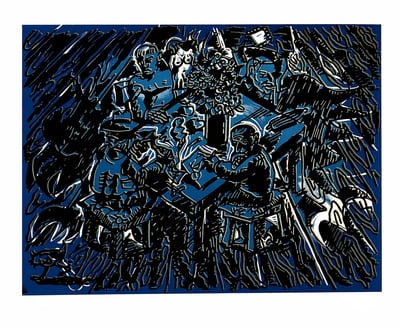
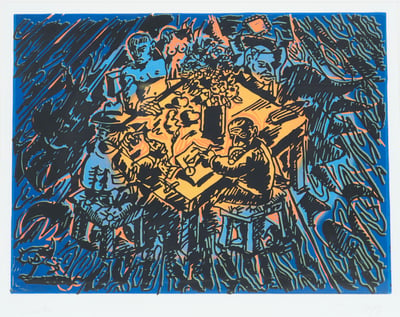
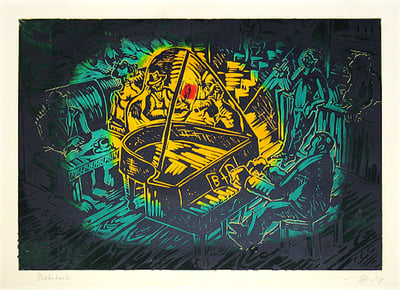
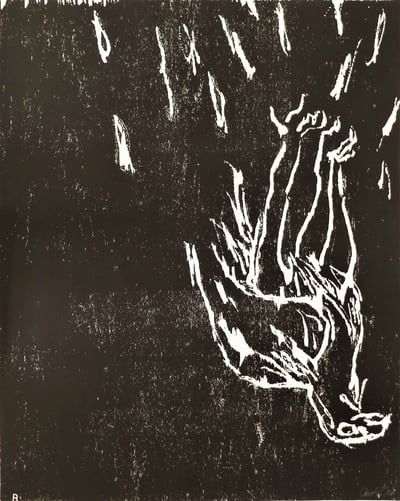
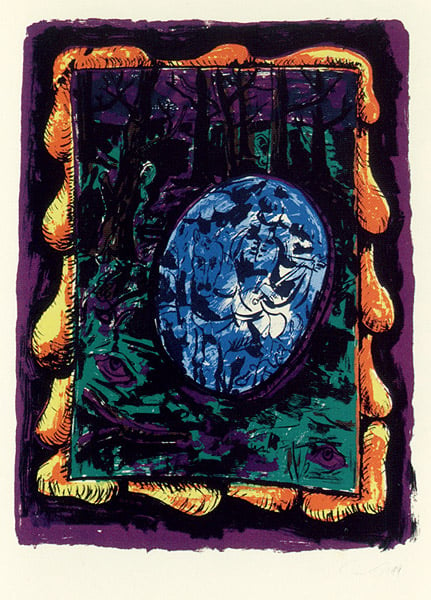
// Malerwald by Jörg Immendorf is a striking silkscreen print that delves into a mystical and surreal world. The artwork features a central, rounded form filled with complex imagery and symbolic figures, encased within a dense forest-like setting. Bold colors like deep purples, greens, and blues dominate the palette, enhancing the mysterious atmosphere. The swirling, organic border, coupled with the shadowy figures and eye motifs around the edges, evoke a sense of the uncanny, as if the viewer is peering into a hidden world. Immendorf’s intricate layering and vibrant contrasts invite exploration, portraying themes of nature, identity, and the subconscious.
Jörg Immendorff (Germany, 1945–2007) was a German painter, sculptor, and stage designer associated with the Neue Wilde movement. His 'Café Deutschland' series critically examined German history and division. Immendorff's politically charged art often featured symbolic imagery, reflecting his engagement with social issues.
Silkscreen Silkscreen is a printmaking method that uses a screen made of silk or other mesh fabric. The screen is treated with a substance that blocks ink in certain areas, allowing ink to pass through only in the desired sections. Each color in the print requires a separate screen.
// Malerwald by Jörg Immendorf is a striking silkscreen print that delves into a mystical and surreal world. The artwork features a central, rounded form filled with complex imagery and symbolic figures, encased within a dense forest-like setting. Bold colors like deep purples, greens, and blues dominate the palette, enhancing the mysterious atmosphere. The swirling, organic border, coupled with the shadowy figures and eye motifs around the edges, evoke a sense of the uncanny, as if the viewer is peering into a hidden world. Immendorf’s intricate layering and vibrant contrasts invite exploration, portraying themes of nature, identity, and the subconscious.
Jörg Immendorff (Germany, 1945–2007) was a German painter, sculptor, and stage designer associated with the Neue Wilde movement. His 'Café Deutschland' series critically examined German history and division. Immendorff's politically charged art often featured symbolic imagery, reflecting his engagement with social issues.
Whether or not the artist can fulfill a social function is a question that remains unanswered.
- Jorg Immendorf
A member of the Neue Wilde movement, Jorg Immendorff received acclaim for his largely figurative work across the mediums of painting and sculpture – Jorg has explained the reason for his figurative style by simply stating: ‘something is beautiful if it is honest’. Among Immendorff’s earliest works was the LIDL group of performances, sculptures and paintings, all of which depicted iconographic motifs that one could expect to find among the make-believe world of a child - motifs included playhouses; goldfish, turtles and dogs, and the body of work was created as a derisive criticism of the present artistic pretensions. Immendorf was influenced by the works of Renato Guttuso, as evidenced in his Café Deutschland work - a series of sixteen large-scale, socio-political paintings that depicted disco-goers as a symbol of the division between East and West Germany. Immendorff was never afraid to challenge the social and political tensions of his time, and was on one occasion arrested for defaming the German flag after appearing outside West German Parliament with a wooden block tethered to his ankle – the block was labeled LIDL and painted in colours of the flag.
Activist Art is a form of art created to address social and political issues. It often involves public engagement and works closely with communities to raise awareness or inspire change. While it can include elements of performance art, it is not limited to this form. Examples include creating and distributing social protest posters or organizing community-based art projects that highlight specific causes.