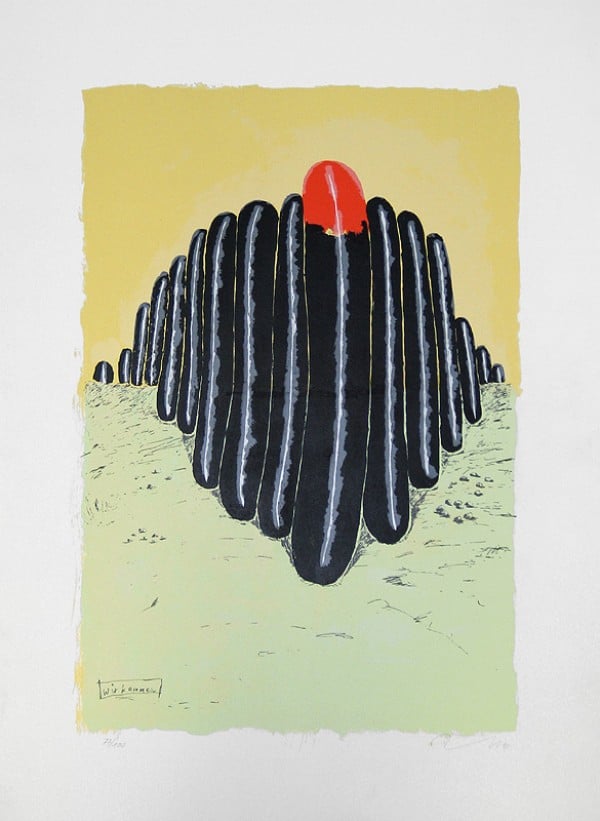
// Wir kommen by Jörg Immendorff, created in 2001, is a silkscreen print that exemplifies the artist's bold approach to symbolism and social commentary. The composition features a line of elongated, vertical black forms, reminiscent of figures or columns, advancing toward the viewer with a sense of movement and intent. The central figure is topped with a vivid red shape, standing out starkly against the muted yellow and green background. This contrast in color and form draws the eye, imbuing the piece with an aura of urgency or impending action. Immendorff often explored themes of collective identity, political engagement, and existential purpose in his work, and Wir kommen (translated as We Are Coming) suggests an organized, purposeful advance. Measuring 106 cm by 76.5 cm, this print invites contemplation on themes of solidarity, movement, and collective determination.
Jörg Immendorff (Germany, 1945–2007) was a German painter, sculptor, and stage designer associated with the Neue Wilde movement. His 'Café Deutschland' series critically examined German history and division. Immendorff's politically charged art often featured symbolic imagery, reflecting his engagement with social issues.
Silkscreen Silkscreen is a printmaking method that uses a screen made of silk or other mesh fabric. The screen is treated with a substance that blocks ink in certain areas, allowing ink to pass through only in the desired sections. Each color in the print requires a separate screen.
// Wir kommen by Jörg Immendorff, created in 2001, is a silkscreen print that exemplifies the artist's bold approach to symbolism and social commentary. The composition features a line of elongated, vertical black forms, reminiscent of figures or columns, advancing toward the viewer with a sense of movement and intent. The central figure is topped with a vivid red shape, standing out starkly against the muted yellow and green background. This contrast in color and form draws the eye, imbuing the piece with an aura of urgency or impending action. Immendorff often explored themes of collective identity, political engagement, and existential purpose in his work, and Wir kommen (translated as We Are Coming) suggests an organized, purposeful advance. Measuring 106 cm by 76.5 cm, this print invites contemplation on themes of solidarity, movement, and collective determination.
Jörg Immendorff (Germany, 1945–2007) was a German painter, sculptor, and stage designer associated with the Neue Wilde movement. His 'Café Deutschland' series critically examined German history and division. Immendorff's politically charged art often featured symbolic imagery, reflecting his engagement with social issues.
Whether or not the artist can fulfill a social function is a question that remains unanswered.
- Jorg Immendorf
A member of the Neue Wilde movement, Jorg Immendorff received acclaim for his largely figurative work across the mediums of painting and sculpture – Jorg has explained the reason for his figurative style by simply stating: ‘something is beautiful if it is honest’. Among Immendorff’s earliest works was the LIDL group of performances, sculptures and paintings, all of which depicted iconographic motifs that one could expect to find among the make-believe world of a child - motifs included playhouses; goldfish, turtles and dogs, and the body of work was created as a derisive criticism of the present artistic pretensions. Immendorf was influenced by the works of Renato Guttuso, as evidenced in his Café Deutschland work - a series of sixteen large-scale, socio-political paintings that depicted disco-goers as a symbol of the division between East and West Germany. Immendorff was never afraid to challenge the social and political tensions of his time, and was on one occasion arrested for defaming the German flag after appearing outside West German Parliament with a wooden block tethered to his ankle – the block was labeled LIDL and painted in colours of the flag.
Neue Wilden is the term German artists used for Neo-Expressionism. In the 1970s and 80s, expressive painting re-emerged in Germany, with artists embracing intense colors and broad brushstrokes. The movement grew in opposition to minimal and conceptual art, favoring a return to raw, emotional expression through bold and dynamic painting techniques.