Hand-signed, dated (front side) -numbered (on reverse side, from an edition of 50) -print and paper size 100cm x 80cm -originally published in the portfolio "Erste Konzentration" 1982 -printed in oil paint on paper by Elke Baselitz (wife of the artist) -very good condition
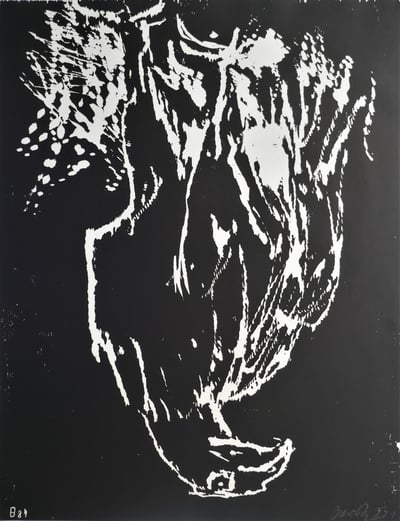
Adler (Eagle) 1 by Georg Baselitz is a striking woodcut print created in 1981, embodying the artist’s bold exploration of human form and existential themes. The piece, rendered in stark black and white, depicts a human figure seemingly falling or suspended upside down amidst abstracted, flame-like shapes. The figure’s body appears contorted, accentuating a sense of descent or struggle. Baselitz’s use of inversion and contrast adds intensity, inviting viewers to confront themes of vulnerability and the human condition. Known for his expressionist style, Baselitz challenges traditional representations, using raw lines and dark tones to evoke profound emotion.
Georg Baselitz (Germany, 1938–2026) was a groundbreaking painter, sculptor, and graphic artist, known for his Neo-Expressionist works. Renowned for inverting his subjects in 1969 to challenge artistic conventions, Baselitz explored themes of memory, identity, and national history. His provocative style profoundly shaped contemporary art.
WoodcutWoodcut is a printing technique where an image is carved into the surface of a woodblock using gouges, with the remaining flat surface holding the ink for printing. The areas cut away by the artist do not carry ink, while the uncut areas do, producing the desired print. The carving follows the wood's grain, unlike wood engraving, where the block is cut across the end-grain. Ink is applied to the surface with a roller, ensuring only the flat, uncarved areas receive ink, leaving the recessed, non-printing areas clean.
Hand-signed, dated (front side) -numbered (on reverse side, from an edition of 50) -print and paper size 100cm x 80cm -originally published in the portfolio "Erste Konzentration" 1982 -printed in oil paint on paper by Elke Baselitz (wife of the artist) -very good condition
Adler (Eagle) 1 by Georg Baselitz is a striking woodcut print created in 1981, embodying the artist’s bold exploration of human form and existential themes. The piece, rendered in stark black and white, depicts a human figure seemingly falling or suspended upside down amidst abstracted, flame-like shapes. The figure’s body appears contorted, accentuating a sense of descent or struggle. Baselitz’s use of inversion and contrast adds intensity, inviting viewers to confront themes of vulnerability and the human condition. Known for his expressionist style, Baselitz challenges traditional representations, using raw lines and dark tones to evoke profound emotion.
Georg Baselitz (Germany, 1938–2026) was a groundbreaking painter, sculptor, and graphic artist, known for his Neo-Expressionist works. Renowned for inverting his subjects in 1969 to challenge artistic conventions, Baselitz explored themes of memory, identity, and national history. His provocative style profoundly shaped contemporary art.
I always feel attacked when I'm asked about my painting.
- Georg Baselitz
Renowned for his expressionistic, often grotesque figurative artwork, Georg Baselitz’s output spanned painting, wood sculpture, and printmaking. His most notable works often addressed questions surrounding Germany’s national identity in the aftermath of the Second World War. He was at the centre of significant controversy in 1980 when he represented Germany at the Venice Biennale, exhibiting a large wooden sculpture that appeared to reference a Nazi salute.
Among Baselitz’s early influences were Art Brut and Abstract Expressionism, as well as the work of artists such as Wassily Kandinsky and Edvard Munch. The exaggerated features present throughout his work were intended as symbolic devices, and one of his most recognised bodies of work is the Hero series, depicting wounded and scarred soldiers in the aftermath of war.
Towards the end of the 1960s, Baselitz began painting his subjects upside down as a deliberate strategy to shift focus away from representation and toward the act of painting itself. His Elke series stands among the most notable examples of this approach.
Artwork by Francis Picabia for sale on composition.gallery
What is dada?
Also known as Dadaism, Dada was a literary and artistic movement that began in 1916 in Zurich, Switzerland. It emerged as a rejection of rationalism and nationalism, which were seen as contributing factors to World War I. The movement had political undertones and was strongly anti-war. Dada activities included demonstrations, gatherings, and the publication of literary and art journals that explored cultural and political topics.