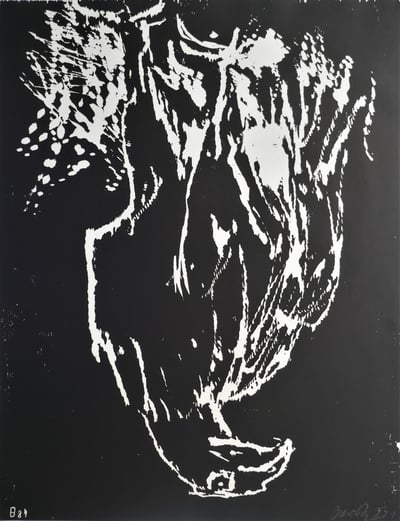
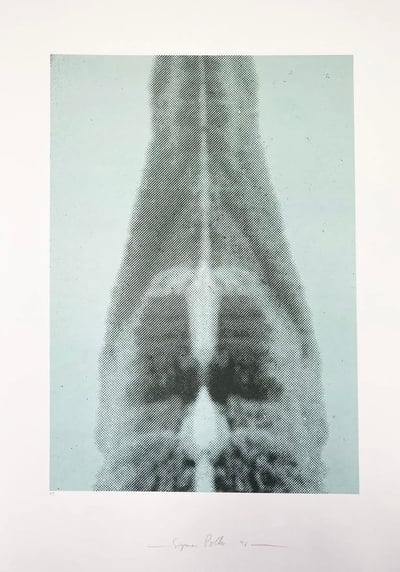
Etching and aquatint in black on a chamois printed background on Somerset white Satin 300gsm - Edition of 15 - paper size 66,5 x 49,5 cm
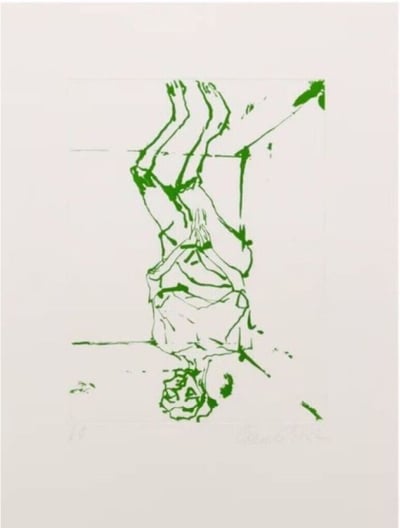
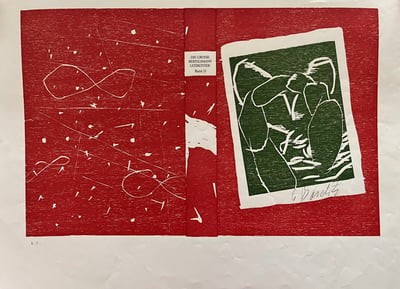
Sono sei piedi by Georg Baselitz, created in 2015, is a limited edition etching and aquatint rendered in black on a subtly textured background. This work features abstracted forms resembling elongated legs and feet, presented with Baselitz's signature expressive linework and gestural marks. The image has an organic, almost chaotic rhythm, as the forms intersect and overlap against the muted chamois-toned background, printed on Somerset white Satin paper. The title, translating to They are six feet, suggests a play on perspective and scale. Known for his exploration of human form and inversion, Baselitz infuses this piece with energy and ambiguity, leaving the viewer to interpret the fluid, almost dance-like movement of the forms.
Georg Baselitz (Germany, 1938–2026) was a groundbreaking painter, sculptor, and graphic artist, known for his Neo-Expressionist works. Renowned for inverting his subjects in 1969 to challenge artistic conventions, Baselitz explored themes of memory, identity, and national history. His provocative style profoundly shaped contemporary art.
Etching and AquatintEtching and aquatint are printmaking techniques. In aquatint, the printing plate is etched with a pattern of tiny pits and cracks to create a wide range of tonal gradations. This technique allows artists to replicate the broad, flat tones found in watercolor paintings and ink washes.
Etching and aquatint in black on a chamois printed background on Somerset white Satin 300gsm - Edition of 15 - paper size 66,5 x 49,5 cm
Sono sei piedi by Georg Baselitz, created in 2015, is a limited edition etching and aquatint rendered in black on a subtly textured background. This work features abstracted forms resembling elongated legs and feet, presented with Baselitz's signature expressive linework and gestural marks. The image has an organic, almost chaotic rhythm, as the forms intersect and overlap against the muted chamois-toned background, printed on Somerset white Satin paper. The title, translating to They are six feet, suggests a play on perspective and scale. Known for his exploration of human form and inversion, Baselitz infuses this piece with energy and ambiguity, leaving the viewer to interpret the fluid, almost dance-like movement of the forms.
Georg Baselitz (Germany, 1938–2026) was a groundbreaking painter, sculptor, and graphic artist, known for his Neo-Expressionist works. Renowned for inverting his subjects in 1969 to challenge artistic conventions, Baselitz explored themes of memory, identity, and national history. His provocative style profoundly shaped contemporary art.
I always feel attacked when I'm asked about my painting.
- Georg Baselitz
Renowned for his expressionistic, often grotesque figurative artwork, Georg Baselitz’s output spanned painting, wood sculpture, and printmaking. His most notable works often addressed questions surrounding Germany’s national identity in the aftermath of the Second World War. He was at the centre of significant controversy in 1980 when he represented Germany at the Venice Biennale, exhibiting a large wooden sculpture that appeared to reference a Nazi salute.
Among Baselitz’s early influences were Art Brut and Abstract Expressionism, as well as the work of artists such as Wassily Kandinsky and Edvard Munch. The exaggerated features present throughout his work were intended as symbolic devices, and one of his most recognised bodies of work is the Hero series, depicting wounded and scarred soldiers in the aftermath of war.
Towards the end of the 1960s, Baselitz began painting his subjects upside down as a deliberate strategy to shift focus away from representation and toward the act of painting itself. His Elke series stands among the most notable examples of this approach.
Neo-Figurative Art is a collective term that refers to the revival of figurative art in America and Europe during the 1960s, following a period dominated by abstraction. Michel Ragon, a French art critic, argued that this resurgence of figuration occurred during a critical time of social and political upheaval in both regions.