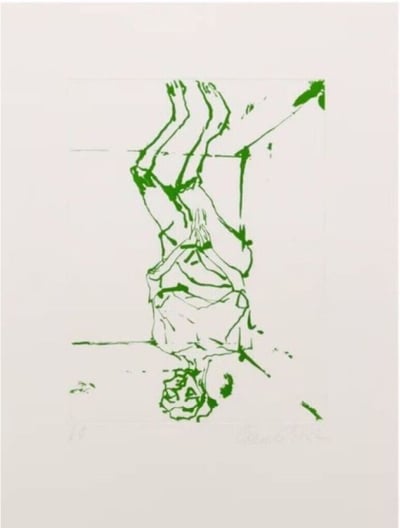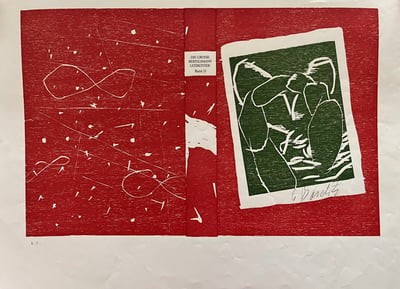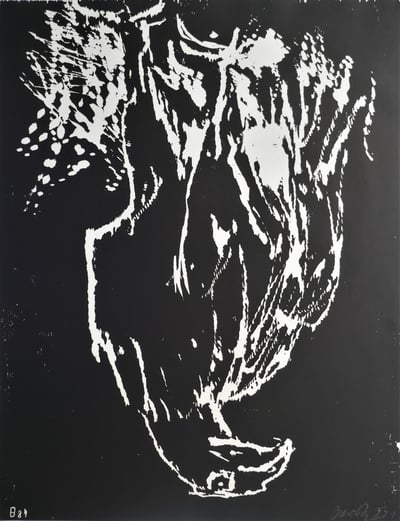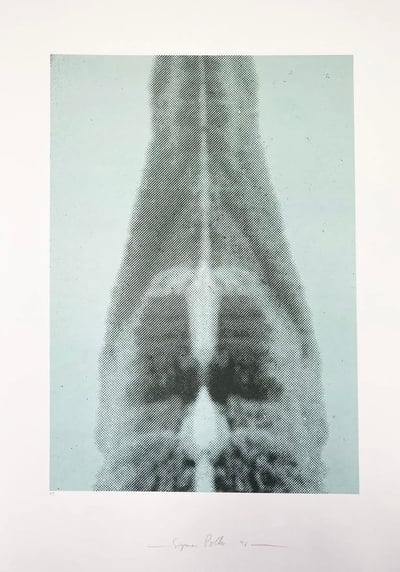
// Georg Baselitz’s Aus der Anatomie (2004) is a limited edition etching that reflects his exploration of human form and deconstruction. The print features abstract, gestural lines forming a loosely defined human figure, with emphasis on irregular, almost fragmented contours. Baselitz’s signature raw, expressive style is evident in the swift, rough strokes that create a sense of motion and tension within the composition. This artwork is part of his broader investigation into anatomy, challenging traditional representations and engaging viewers with a visceral, almost primal interpretation of the human body. The etching, measuring 84.5 x 65.5 cm, presents Baselitz’s dynamic approach to the medium, emphasizing spontaneity and emotional impact over precision.
Georg Baselitz (Germany, 1938–2026) was a groundbreaking painter, sculptor, and graphic artist, known for his Neo-Expressionist works. Renowned for inverting his subjects in 1969 to challenge artistic conventions, Baselitz explored themes of memory, identity, and national history. His provocative style profoundly shaped contemporary art.
EtchingEtching is a technique where a design is created on a metal surface by using a strong acid or mordant to eat away the unprotected parts of the metal, leaving the desired pattern in relief (intaglio). In modern art and manufacturing, different chemicals may be used depending on the material being etched.
// Georg Baselitz’s Aus der Anatomie (2004) is a limited edition etching that reflects his exploration of human form and deconstruction. The print features abstract, gestural lines forming a loosely defined human figure, with emphasis on irregular, almost fragmented contours. Baselitz’s signature raw, expressive style is evident in the swift, rough strokes that create a sense of motion and tension within the composition. This artwork is part of his broader investigation into anatomy, challenging traditional representations and engaging viewers with a visceral, almost primal interpretation of the human body. The etching, measuring 84.5 x 65.5 cm, presents Baselitz’s dynamic approach to the medium, emphasizing spontaneity and emotional impact over precision.
Georg Baselitz (Germany, 1938–2026) was a groundbreaking painter, sculptor, and graphic artist, known for his Neo-Expressionist works. Renowned for inverting his subjects in 1969 to challenge artistic conventions, Baselitz explored themes of memory, identity, and national history. His provocative style profoundly shaped contemporary art.
I always feel attacked when I'm asked about my painting.
- Georg Baselitz
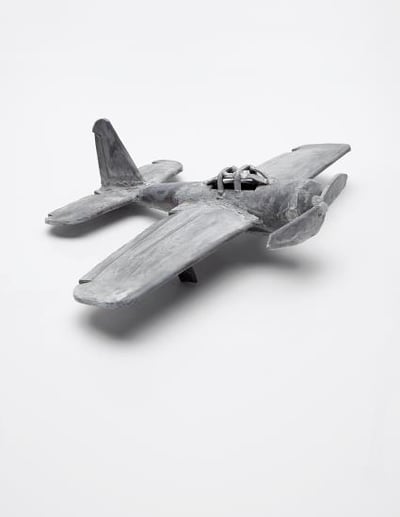
Renowned for his expressionistic, often grotesque figurative artwork, Georg Baselitz’s output spanned painting, wood sculpture, and printmaking. His most notable works often addressed questions surrounding Germany’s national identity in the aftermath of the Second World War. He was at the centre of significant controversy in 1980 when he represented Germany at the Venice Biennale, exhibiting a large wooden sculpture that appeared to reference a Nazi salute.
Among Baselitz’s early influences were Art Brut and Abstract Expressionism, as well as the work of artists such as Wassily Kandinsky and Edvard Munch. The exaggerated features present throughout his work were intended as symbolic devices, and one of his most recognised bodies of work is the Hero series, depicting wounded and scarred soldiers in the aftermath of war.
Towards the end of the 1960s, Baselitz began painting his subjects upside down as a deliberate strategy to shift focus away from representation and toward the act of painting itself. His Elke series stands among the most notable examples of this approach.
Sometimes known as Figurativism, figurative art refers to sculptures and paintings that are clearly or specifically derived from real objects, making them representational. The term figurative art is often used in contrast to abstract art. However, since the emergence of abstract art, figurative art has come to describe any form of modern art that has strong references to the real world or actual situations.