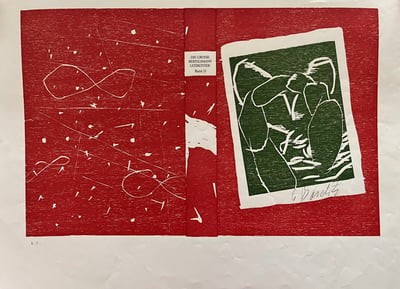
Die Grosse... by Georg Baselitz, a limited edition serigraph from 1992, exemplifies Baselitz's distinctive style of combining abstract forms with vibrant, contrasting colors. This print features a two-panel composition with a bold red background that dominates the piece. On the left panel, abstract linear designs float amidst scattered white specks, evoking a sense of movement and cosmic energy. The right panel presents an expressive green form outlined in white, resembling a stylized, fragmented figure or organic shape. Baselitz’s use of strong, contrasting colors and unconventional forms invites the viewer to explore themes of abstraction, disorientation, and the subconscious. Known for challenging artistic norms, Baselitz incorporates elements that provoke thought on balance and chaos, making this piece a compelling study of modern expression.
Georg Baselitz (Germany, 1938–2026) was a groundbreaking painter, sculptor, and graphic artist, known for his Neo-Expressionist works. Renowned for inverting his subjects in 1969 to challenge artistic conventions, Baselitz explored themes of memory, identity, and national history. His provocative style profoundly shaped contemporary art.
Serigraph Serigraph is a printmaking process that uses silk screen techniques to create an image. The image is digitally separated into individual colors, each of which is assigned to a separate silk screen. These screens are then used to apply each color by hand, layer by layer, to replicate the original artwork, often based on an oil painting.
Die Grosse... by Georg Baselitz, a limited edition serigraph from 1992, exemplifies Baselitz's distinctive style of combining abstract forms with vibrant, contrasting colors. This print features a two-panel composition with a bold red background that dominates the piece. On the left panel, abstract linear designs float amidst scattered white specks, evoking a sense of movement and cosmic energy. The right panel presents an expressive green form outlined in white, resembling a stylized, fragmented figure or organic shape. Baselitz’s use of strong, contrasting colors and unconventional forms invites the viewer to explore themes of abstraction, disorientation, and the subconscious. Known for challenging artistic norms, Baselitz incorporates elements that provoke thought on balance and chaos, making this piece a compelling study of modern expression.
Georg Baselitz (Germany, 1938–2026) was a groundbreaking painter, sculptor, and graphic artist, known for his Neo-Expressionist works. Renowned for inverting his subjects in 1969 to challenge artistic conventions, Baselitz explored themes of memory, identity, and national history. His provocative style profoundly shaped contemporary art.
I always feel attacked when I'm asked about my painting.
- Georg Baselitz
Renowned for his expressionistic, often grotesque figurative artwork, Georg Baselitz’s output spanned painting, wood sculpture, and printmaking. His most notable works often addressed questions surrounding Germany’s national identity in the aftermath of the Second World War. He was at the centre of significant controversy in 1980 when he represented Germany at the Venice Biennale, exhibiting a large wooden sculpture that appeared to reference a Nazi salute.
Among Baselitz’s early influences were Art Brut and Abstract Expressionism, as well as the work of artists such as Wassily Kandinsky and Edvard Munch. The exaggerated features present throughout his work were intended as symbolic devices, and one of his most recognised bodies of work is the Hero series, depicting wounded and scarred soldiers in the aftermath of war.
Towards the end of the 1960s, Baselitz began painting his subjects upside down as a deliberate strategy to shift focus away from representation and toward the act of painting itself. His Elke series stands among the most notable examples of this approach.
Neue Wilden is the term German artists used for Neo-Expressionism. In the 1970s and 80s, expressive painting re-emerged in Germany, with artists embracing intense colors and broad brushstrokes. The movement grew in opposition to minimal and conceptual art, favoring a return to raw, emotional expression through bold and dynamic painting techniques.