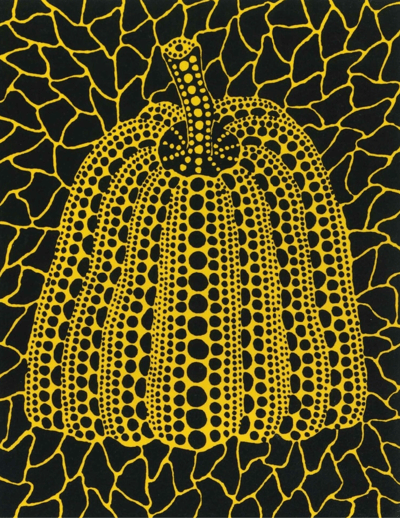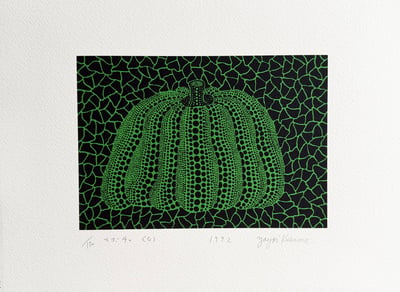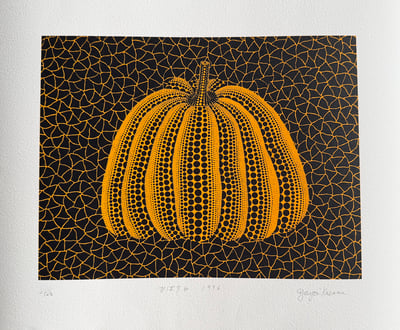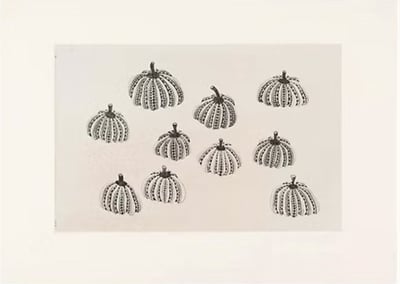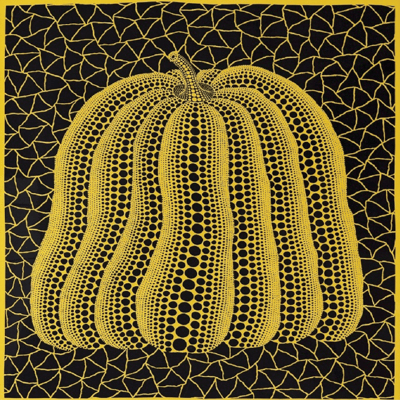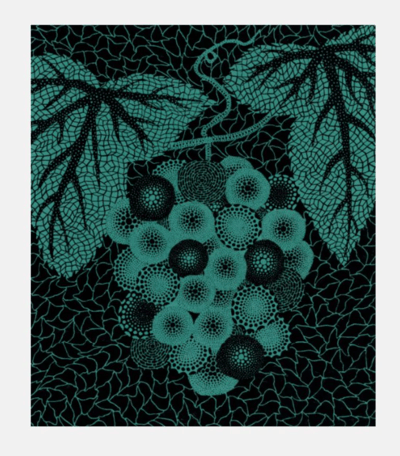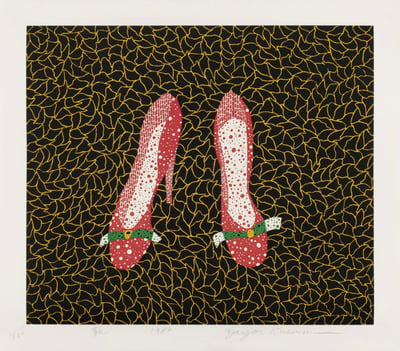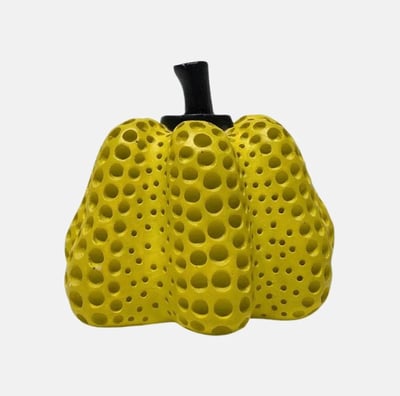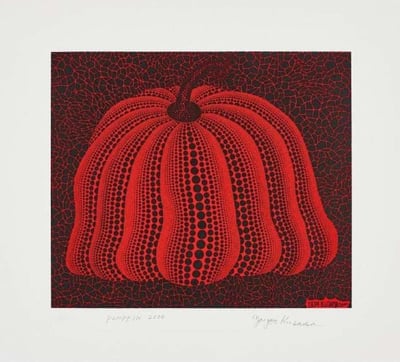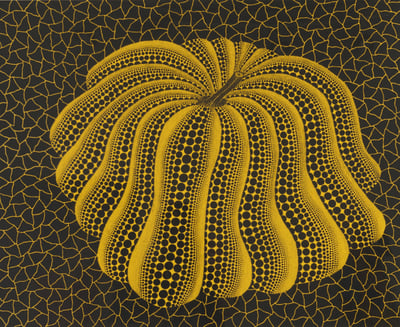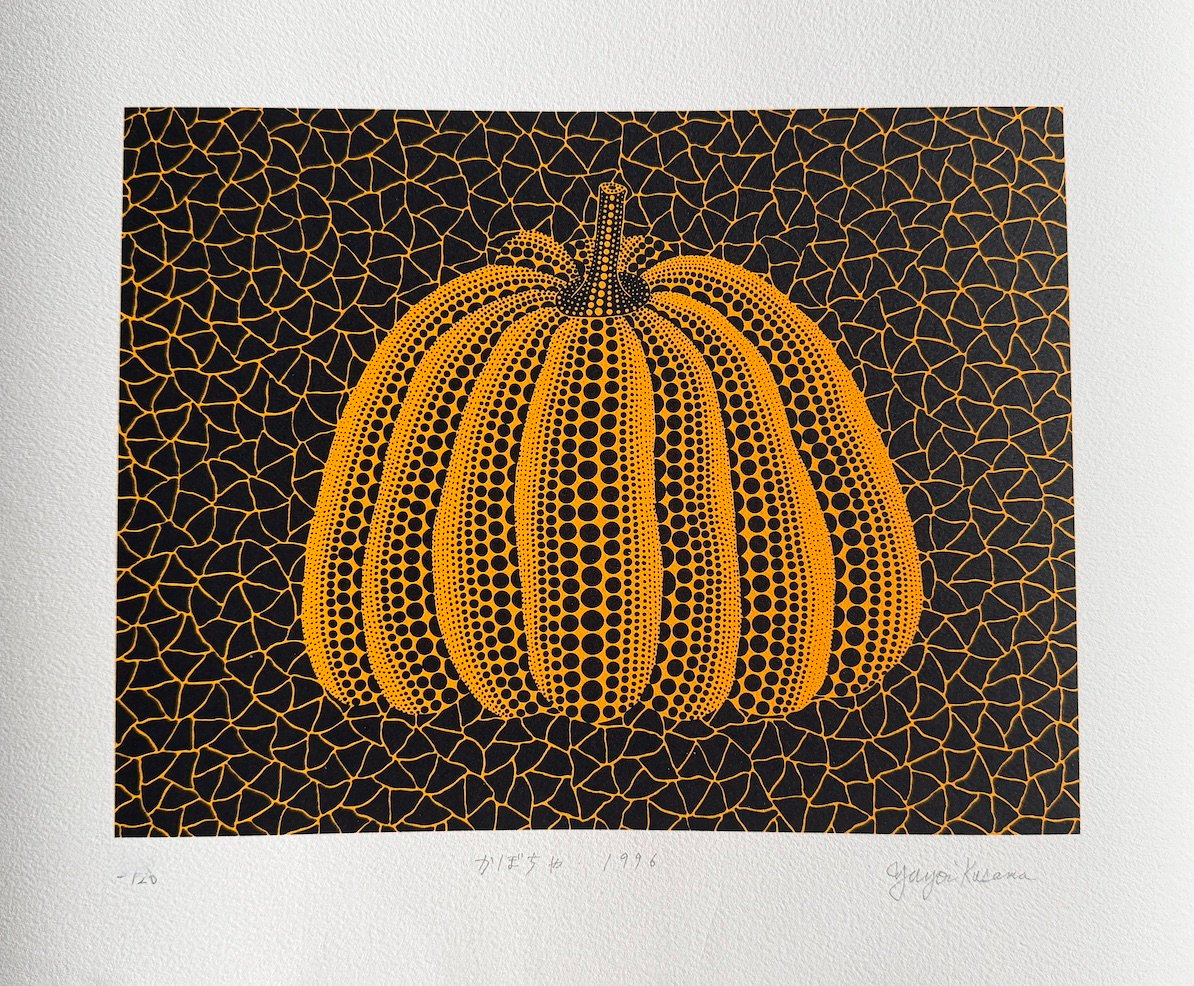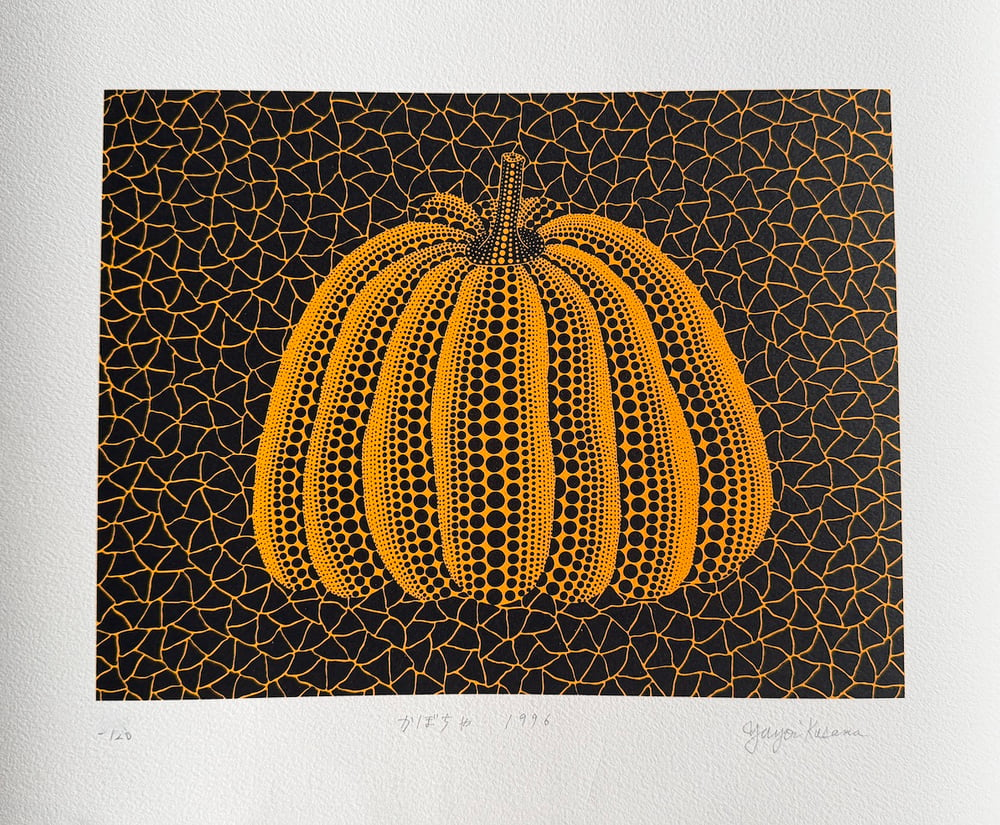
'Pumpkin (YY)' by Yayoi Kusama is a 1996 screen-print measuring 32.4 × 40 cm, hand-signed and editioned below the image. A single large pumpkin, rendered in vivid amber-orange, sits centrally against a deep black ground. The surface of the pumpkin is covered in graduated black polka dots arranged in vertical columns that follow the vegetable's ribbed form, while the background is filled with an interlocking web of irregular amber cells — a net pattern that holds the same visual language as the foreground figure. Kusama first adopted the pumpkin as a recurring motif in the 1940s, drawn to what she described as its humble, human quality. The dotted surface is inseparable from her broader obsession with repetitive mark-making, rooted in the hallucinatory experiences she has spoken about throughout her career. 'Pumpkin (YY)' belongs to a series of pumpkin screen-prints produced in the 1990s that brought this imagery to a wider audience during Kusama's international resurgence.
Yayoi Kusama (Japan, 1929) is a pioneering artist known for her avant-garde vision, using polka dots, mirrors, and immersive installations to explore themes of infinity and self-obliteration. Her 'Infinity Rooms' and bold, colorful works have redefined contemporary art, influencing pop art and minimalism. Kusama’s art blends obsession with beauty and transcendence, making her globally celebrated.
Screen-print Screen printing is a technique where ink is transferred through a mesh onto a substrate, with areas blocked by a stencil to prevent ink from passing through. This method, also known as serigraphy or silkscreen printing, is commonly used to produce prints on posters, T-shirts, vinyl, stickers, wood, and other materials. The process is a type of stencil printing, allowing for vibrant, detailed designs on various surfaces.
'Pumpkin (YY)' by Yayoi Kusama is a 1996 screen-print measuring 32.4 × 40 cm, hand-signed and editioned below the image. A single large pumpkin, rendered in vivid amber-orange, sits centrally against a deep black ground. The surface of the pumpkin is covered in graduated black polka dots arranged in vertical columns that follow the vegetable's ribbed form, while the background is filled with an interlocking web of irregular amber cells — a net pattern that holds the same visual language as the foreground figure. Kusama first adopted the pumpkin as a recurring motif in the 1940s, drawn to what she described as its humble, human quality. The dotted surface is inseparable from her broader obsession with repetitive mark-making, rooted in the hallucinatory experiences she has spoken about throughout her career. 'Pumpkin (YY)' belongs to a series of pumpkin screen-prints produced in the 1990s that brought this imagery to a wider audience during Kusama's international resurgence.
Yayoi Kusama (Japan, 1929) is a pioneering artist known for her avant-garde vision, using polka dots, mirrors, and immersive installations to explore themes of infinity and self-obliteration. Her 'Infinity Rooms' and bold, colorful works have redefined contemporary art, influencing pop art and minimalism. Kusama’s art blends obsession with beauty and transcendence, making her globally celebrated.
My life is a dot lost among thousands of other dots.
- Yayoi Kusama
Celebrated for her liberal and multi-faceted approach to creation, Yayoi Kusama is a prominent artist who works primarily across the mediums of installation and sculpture, as well as performance, poetry and painting – Kusama has a unique style with works spanning minimalism, surrealism, conceptual art and abstract expression. Among Kusama's acclaimed works is Grand Orgy to Awaken the Dead, one among many highly public ‘happenings’, in which naked participants were covered in a range of brightly coloured polka-dots; these dots, as well as the theme of infinity, became signature traits of her art – Kasuma has commented on the repetitive nature of her creativity in describing herself as an ‘obsessive artist’. Kusama counts fellow artists Eva Hesse and Donald Judd as close friends and influences, and her work has also been of inspiration to Andy Warhol and the Pop Art style. (Artist website)
Environmental art is a collective term that refers to a wide range of artistic practices and works that engage with historical and ecological themes. The term often encompasses ecological concerns, although it is not exclusively defined by them. Environmental art acknowledges and appreciates the early history of the environmental art movement, including works with activist themes and those celebrating the connection between nature and the artist through the use of natural materials.